
The following blog post is for entertainment and informational purposes only. It is not intended to provide medical advice or diagnosis. Please consult your doctor before making any health-related decisions.
Men starting hormone therapy frequently ask about enclomiphene prostate cancer risk and whether this SERM approach carries the same concerns as testosterone replacement therapy (TRT). Current evidence does not show that enclomiphene causes prostate cancer. Its mechanism differs from TRT in ways that matter clinically for prostate health. Men with pre-existing prostate concerns require individualized evaluation, and understanding enclomiphene treatment is a reasonable first step before any licensed provider conversation.
How enclomiphene works and why the mechanism matters
Enclomiphene is a selective estrogen receptor modulator, or SERM. It blocks estrogen receptors in the hypothalamus and pituitary, reducing negative feedback on the hypothalamic-pituitary-gonadal (HPG) axis. The pituitary then releases more LH and FSH. The testes respond by producing more testosterone. The HPG axis stays active throughout.
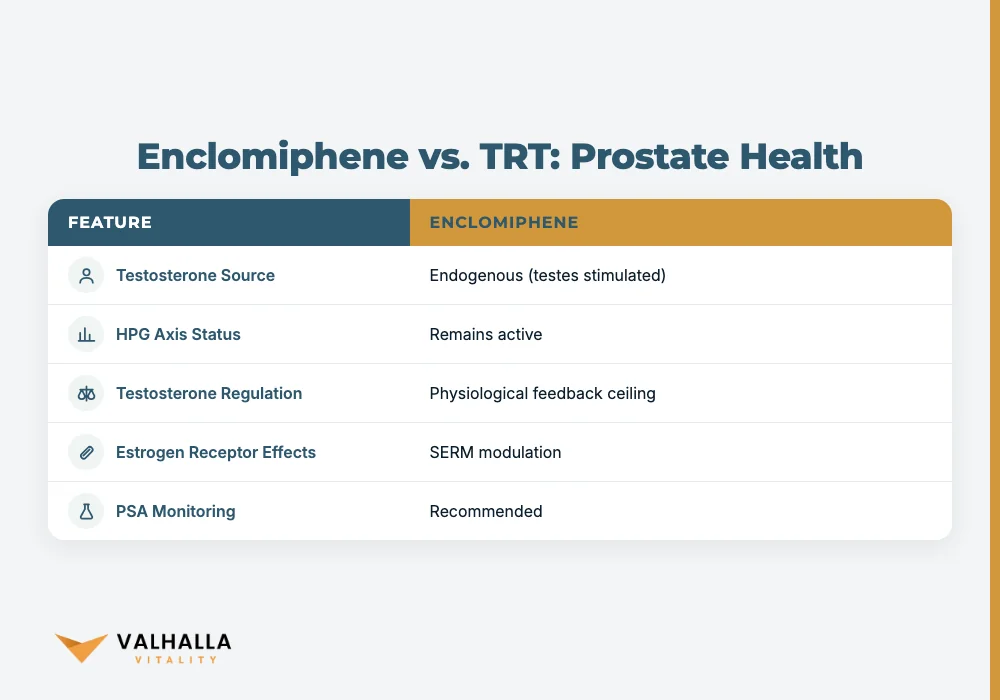
That last point defines the enclomiphene vs TRT prostate comparison. The table below highlights the key differences relevant to prostate health.
| Feature | Enclomiphene | TRT |
|---|---|---|
| Testosterone source | Endogenous (testes stimulated) | Exogenous (external delivery) |
| HPG axis status | Remains active | Suppressed |
| Testosterone regulation | Physiological feedback ceiling | Dose-dependent, no natural ceiling |
| Estrogen receptor effects | SERM modulation | No direct SERM activity |
| PSA monitoring recommended | Yes | Yes |
SERM prostate safety is not identical to the prostate safety profile of exogenous testosterone. Enclomiphene modulates estrogen receptors primarily in the hypothalamic-pituitary axis. Estrogen receptors are also present in prostate tissue, and the interplay between androgen and estrogen signaling there is complex and not yet fully characterized. The article on enclomiphene's influence on estrogen pathways covers the receptor-level mechanics in more detail.
!enclomiphene prostate cancer risk PSA monitoring and BPH considerations-01KVQMA4PW0YD08A8SEGDCBVTY.webp)
Enclomiphene prostate cancer risk: what the research shows
Earlier clinical models assumed elevated testosterone drives prostate cancer growth. That assumption came from observing that androgen deprivation suppresses advanced prostate cancer. The testosterone prostate saturation model, examined by Ory et al. (2020) in the Canadian Urological Association Journal, challenges that reasoning: prostate androgen receptors appear to saturate at relatively low testosterone concentrations, and increases above that threshold may not meaningfully raise cancer risk in most men.
For enclomiphene prostate cancer specifically, the available evidence is indirect but notable:
- Enclomiphene raises endogenous testosterone through the HPG axis, not via external administration
- The active feedback loop limits how far testosterone rises, unlike TRT where levels depend on dose
- A 2016 study by Chandrapal et al. in BJU International tracked PSA in men using clomiphene (the parent compound of enclomiphene) and found no clinically meaningful PSA elevations
- A 2025 systematic review and meta-analysis by Hohl et al. in Archives of Endocrinology and Metabolism, covering randomized controlled trials of clomiphene and enclomiphene in male hypogonadism, reported no prostate harm signal across the included trials
No large-scale, long-term study has examined enclomiphene prostate cancer outcomes as a primary endpoint. Absence of evidence of harm is not confirmed safety. Men with a prostate cancer history are generally not candidates for hormone-stimulating therapies, including enclomiphene.
Does enclomiphene raise PSA levels?
Monitoring enclomiphene PSA levels is standard clinical practice. Any therapy that raises testosterone can potentially influence PSA, since testosterone metabolism contributes to PSA production in the prostate. Addressing enclomiphene prostate cancer risk in practice means establishing a PSA baseline before starting therapy and tracking it at follow-up intervals.
The Chandrapal et al. (2016) study found no clinically significant PSA elevations in men using clomiphene over the study period. Individual responses vary. A meaningful PSA increase during enclomiphene therapy warrants further evaluation regardless of the suspected cause. Since clomiphene is the racemic parent compound from which enclomiphene is derived, the PSA data is directly relevant; the article on the clinical relationship between enclomiphene and clomiphene provides additional context on how these compounds compare.
Men with an elevated PSA or an ongoing prostate evaluation should resolve those questions before starting any testosterone-affecting therapy. A clear PSA baseline is part of a well-structured provider intake.
How does enclomiphene affect the prostate compared to TRT?
The enclomiphene vs TRT prostate comparison centers on how testosterone is elevated and how that elevation is regulated. TRT produces testosterone increases driven by the external dose. The HPG axis shuts down. There is no physiological ceiling. Enclomiphene keeps that ceiling in place.
Khera et al. (2015), writing in Therapeutic Advances in Urology, reviewed the evidence on testosterone and prostate oncology. They found the relationship more complex than early models assumed, with saturation model principles providing a plausible explanation for why moderate testosterone increases may carry limited additional cancer risk. Whether those findings apply equally to enclomiphene hypogonadism safety remains an open question. Direct long-term comparative prostate data between the two therapies does not yet exist from large clinical trials.
Is enclomiphene safe for men with prostate issues?
The answer depends on the specific issue. Enclomiphene BPH risk has not been the subject of dedicated trials. Enclomiphene raises testosterone, and testosterone converts to dihydrotestosterone (DHT), which influences prostate tissue. Men with existing BPH may notice changes in urinary symptoms. Whether that is clinically significant depends on the severity of BPH, current symptom burden, and baseline hormone levels.
Rodriguez KM et al. (2016), writing in Expert Opinion on Pharmacotherapy, reviewed enclomiphene's pharmacodynamic profile in secondary hypogonadism and noted a favorable overall safety picture. Prostate outcomes were not the primary endpoint of that work, so no specific conclusions on enclomiphene BPH risk follow from it directly. At Valhalla Vitality, prostate health is reviewed as part of the standard provider intake before any therapy recommendation is made.
Men with prostate concerns generally fit one of three categories:
- Prostate cancer history: not a typical candidate for hormone-stimulating therapies, including enclomiphene
- Elevated PSA or active evaluation: those issues should be fully addressed before starting enclomiphene
- BPH with managed symptoms: may be considered with close monitoring, but only through a provider's individualized assessment
For a full overview of enclomiphene's safety considerations and monitoring protocol, including what follow-up care typically involves, that reference walks through standard clinical practice.
Take the next step with a provider review
Book Your Consultation to speak with a licensed provider who can assess your specific prostate health factors before any therapy decision is made.
FAQ
Does enclomiphene cause prostate cancer?
No current clinical evidence shows that enclomiphene causes prostate cancer. The therapy raises endogenous testosterone through the HPG axis, which involves natural feedback regulation not present with exogenous testosterone. Men with a prostate cancer history should consult a qualified provider before considering any hormone-stimulating therapy.
Is enclomiphene safe for men with prostate issues?
Whether enclomiphene is appropriate depends on the type of prostate concern, its severity, and baseline lab values. Men with a prostate cancer history are generally not candidates, while men with BPH or an elevated PSA need individualized provider evaluation before starting any testosterone-affecting therapy.
Does enclomiphene raise PSA levels?
A 2016 study by Chandrapal et al. found no clinically significant PSA elevations in men using clomiphene, the parent compound, over the study period. Some change is possible with any therapy that raises testosterone, and PSA baseline testing before starting enclomiphene is standard practice. Significant elevations during treatment warrant further investigation.
How does enclomiphene affect the prostate compared to TRT?
Enclomiphene raises testosterone through the HPG axis, which provides a natural feedback ceiling on how high levels climb. TRT delivers testosterone externally and suppresses that axis, typically producing larger and less physiologically regulated elevations. Long-term comparative prostate safety data between the two approaches has not yet been produced in large clinical trials.
Can men with BPH use enclomiphene?
Some men with BPH may be considered for enclomiphene, but the decision requires a provider's individualized assessment rather than a general recommendation. Testosterone conversion to DHT can influence prostate tissue, so BPH severity, current symptoms, and baseline lab values all factor into the evaluation.
Sources
- Chandrapal JC, et al. (2016). Characterising the safety of clomiphene citrate in male patients through prostate-specific antigen, haematocrit, and testosterone levels. BJU International. PubMed
- Khera M, et al. (2015). Testosterone and prostate cancer: an evidence-based review of pathogenesis and oncologic risk. Therapeutic Advances in Urology. PubMed
- Hohl A, et al. (2025). Clomiphene or enclomiphene citrate for the treatment of male hypogonadism: a systematic review and meta-analysis of randomized controlled trials. Archives of Endocrinology and Metabolism. PubMed
- Ory J, et al. (2020). Questioning the evidence behind the Saturation Model for testosterone replacement therapy in prostate cancer. Canadian Urological Association Journal. PubMed
- Rodriguez KM, et al. (2016). Enclomiphene citrate for the treatment of secondary male hypogonadism. Expert Opinion on Pharmacotherapy. PubMed
You May Also Like
 Enclomiphene
Enclomiphene Before and After: Physical Changes Explained
Enclomiphene before and after: what physical changes to expect, how the results timeline unfolds, and why provider monitoring matters for outcomes.
October 21, 2026 ETRead more → Enclomiphene
Enclomiphene Vision Side Effects: Eye Floaters & More
Enclomiphene vision side effects include eye floaters, blurry vision, and light sensitivity. Know the warning signs and when to contact your provider.
October 21, 2026 ETRead more → Enclomiphene
Enclomiphene Drug Test: Detection, WADA, and Disclosure
Enclomiphene drug test detection depends on the test type. Learn how workplace panels, military screening, and WADA rules treat this SERM.
October 21, 2026 ETRead more →