
The following blog post is for entertainment and informational purposes only. It is not intended to provide medical advice or diagnosis. Please consult your doctor before making any health-related decisions.
The negative effects of smoking reach every major organ system in the body. Smoking is the single leading cause of preventable death worldwide, responsible for cancer, heart disease, stroke, and chronic lung disease. According to the World Health Organization (2021), tobacco causes roughly one in three cancers globally and is the primary modifiable driver behind most cases of COPD and stroke. If you want a clear picture of your personal smoking health risks or want to explore quitting options, speaking with a licensed provider is the most direct route to personalized answers.
What are the negative effects of smoking on the body?
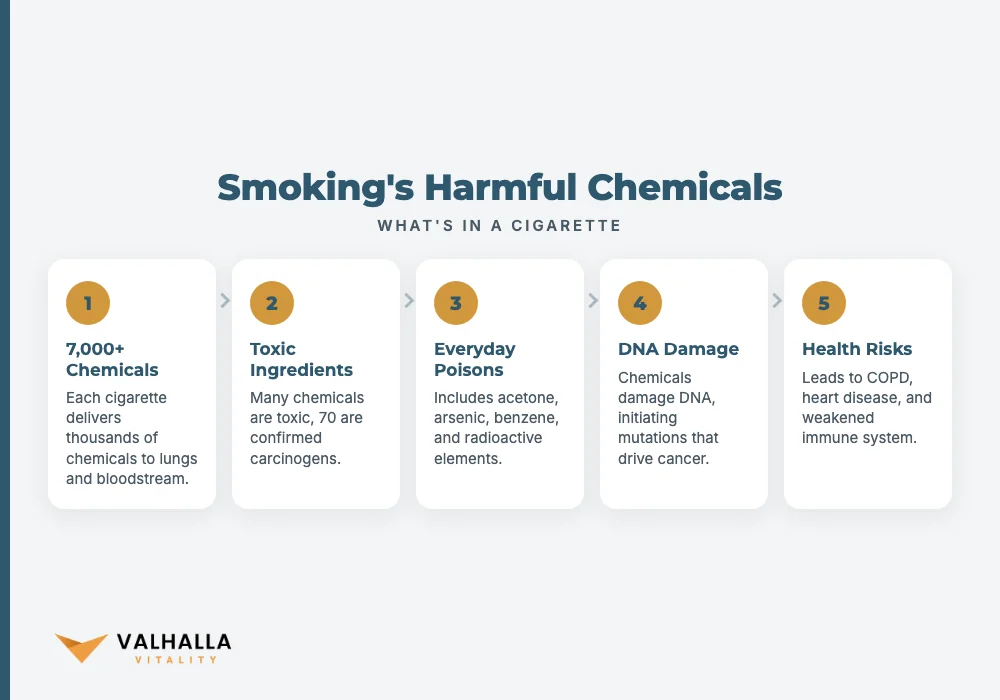
Each cigarette delivers more than 7,000 chemicals directly into the lungs and bloodstream, according to the National Cancer Institute (2020). Many are toxic at any exposure level. At least 70 are confirmed carcinogens. Some are industrial solvents, pesticide ingredients, or radioactive elements that the body has no mechanism to process safely.
Here are several well-documented cigarette harmful chemicals found in tobacco smoke and where they also appear outside cigarettes:
| Chemical | Common use outside cigarettes |
|---|---|
| Acetone | Nail polish remover |
| Acrolein | Agricultural herbicide |
| Arsenic | Rat poison |
| Benzene | Gasoline additive |
| Formaldehyde | Preservative used in mortuaries |
| Polonium-210 | Radioactive element |
These are not trace impurities. They accumulate with every cigarette and compound across years of use. The American Cancer Society (2020) confirmed that tobacco smoke chemicals damage DNA directly inside cell nuclei, initiating the mutations that drive cancer development across multiple tissue types.
The smoking health risks extend well beyond the airways:
- COPD: Chronic obstructive pulmonary disease causes progressive, irreversible airflow limitation. Smokers develop it at far higher rates than non-smokers, with symptoms that include persistent cough, chronic breathlessness, and significantly reduced physical endurance.
- Cardiovascular disease: Tobacco chemicals narrow arteries, accelerate plaque formation, and raise blood clotting tendency, directly increasing the probability of heart attack and stroke.
- Immune system: The WHO (2021) linked smoking to more severe respiratory infections, more frequent asthma exacerbations, and broadly weakened immune defenses.
- Metabolic health: Smoking worsens blood sugar control in people with type 2 diabetes, accelerating organ damage that careful management otherwise slows.
The damage is systemic. It does not stay confined to the airways where smoke first enters.
Smoking and cancer: what the evidence says
Smoking and cancer share one of the most thoroughly documented causal relationships in medicine. The American Cancer Society (2020) confirmed that tobacco-driven DNA mutations occur across multiple tissue types, not only in respiratory tissue. Cancers directly linked to smoking include those of the lungs, larynx, esophagus, mouth, throat, stomach, kidney, bladder, and cervix.
Lung cancer remains the most lethal outcome. Smokers face a dramatically higher probability of developing it compared to non-smokers, and the risk rises with both daily cigarette count and total years of use.
Pancreatic cancer is among the hardest to treat at any stage, and it also has a clear tobacco connection. A 2025 review published in the Lancet identified tobacco use as one of the primary modifiable risk factors for pancreatic cancer (Stoop et al., 2025). The negative effects of smoking on cancer risk extend far beyond the lungs and do not spare organs remote from the airway.
Cigarette smoke does not need to produce visible symptoms to be causing genetic damage. Years of subclinical DNA repair errors accumulate silently before a detectable lesion forms. That latency is part of what makes tobacco-related cancers difficult to catch early. There is no exposure threshold below which cigarettes are biologically safe. Cutting back reduces risk incrementally; stopping entirely changes the trajectory more substantially.
Smoking and heart disease: what the research shows
Smoking and heart disease are causally linked through several parallel biological mechanisms. Tobacco chemicals inflame artery walls, accelerate arterial plaque buildup, raise resting blood pressure, and make blood more prone to clotting. The WHO (2021) identified smoking as one of the primary drivers of cardiovascular death worldwide.
Each cigarette triggers an acute spike in blood pressure and heart rate. Over years, those repeated acute exposures cause structural changes to arterial walls that do not fully resolve on their own. Research into how substances that affect vascular tone influence cardiac outcomes demonstrates how sensitively the cardiovascular system responds to chemical stress. For smokers, that stress is continuous. Even people who smoke relatively few cigarettes per day carry meaningfully elevated cardiovascular risk compared to non-smokers.
Blood vessel health begins to improve within months of quitting. Blood pressure stabilizes. Arterial inflammation decreases. The trajectory of cardiovascular risk improves, though in long-term heavy smokers it may not return to a never-smoker baseline in all respects.
How does smoking affect mental health?
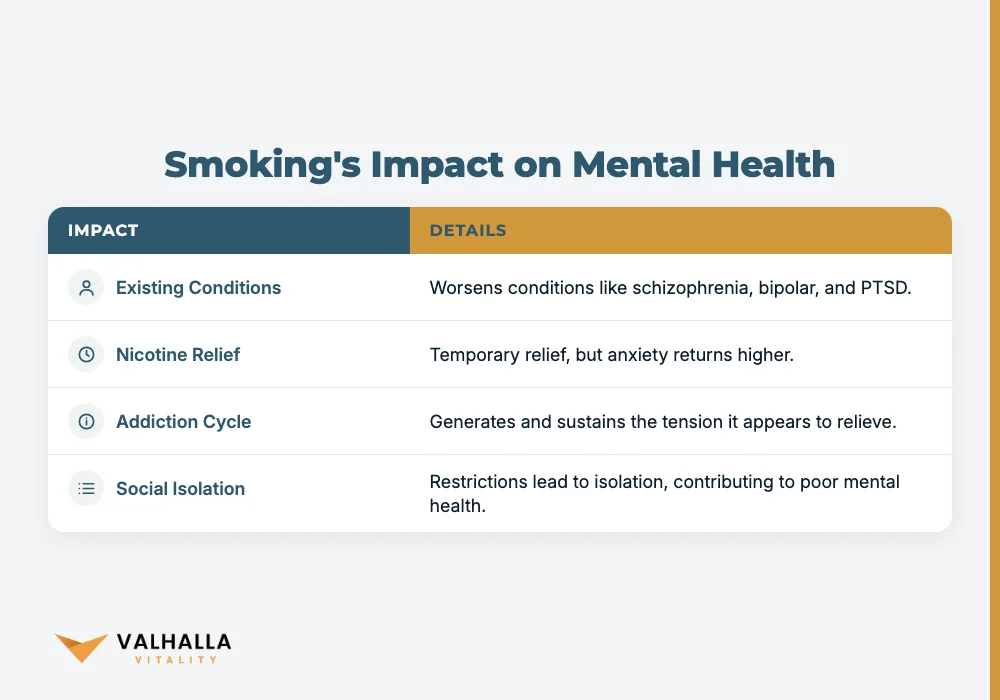
Smoking and mental health interact in a reinforcing cycle that is easy to misinterpret. Smokers are more likely to develop anxiety and depression than non-smokers. People with existing mental health conditions are also more likely to smoke and typically harder to help quit. The Mental Health Foundation (2021) documented that smoking increases the risk of developing anxiety and depression and worsens conditions that are already present, including serious psychiatric disorders such as schizophrenia, bipolar disorder, and PTSD.
Nicotine temporarily relieves the tension that withdrawal itself creates. That relief is real. It is also brief. When nicotine levels fall, baseline anxiety returns, often at a higher level than before smoking began. Most smokers interpret this as evidence that smoking helps them manage stress. In practice, the addiction generates and sustains the tension it appears to relieve.
Social exclusion adds another layer. Smoking restrictions in offices, restaurants, and other public settings mean smokers are increasingly isolated during social and professional occasions. Chronic social isolation is a known contributor to poor mental health. Research on how social connection and isolation shape mental well-being reinforces why the social consequences of smoking cannot be separated from its psychological ones.
Can smoking cause hormonal imbalances?
Yes. Smoking disrupts the endocrine system in measurable ways. In men, tobacco use has been associated with lower testosterone levels and reduced sperm quality and motility. In women, smoking has been linked to accelerated loss of ovarian follicles, often advancing the onset of menopause earlier than it would otherwise occur.
Tobacco chemicals have also been associated with elevated cortisol and disrupted hormonal signaling more broadly in chronic smokers. Sustained cortisol elevation affects sleep quality, immune function, bone density, and fat metabolism. These are physiologically significant changes, not cosmetic concerns. They compound over the course of a smoking history. The negative effects of smoking on hormonal balance are among the least-discussed but most wide-ranging consequences of long-term tobacco use. A licensed provider can assess hormonal status through lab work and determine whether any evaluation or support is appropriate given your full health picture.
Is vaping safer than cigarettes?
No. Vaping is not a safe alternative to smoking. This claim is repeated frequently, and the evidence does not support it. E-cigarette vapor contains diacetyl, a chemical linked to a serious and often irreversible lung condition called bronchiolitis obliterans. It also contains volatile organic compounds and heavy metals including nickel, tin, and lead, according to the Centers for Disease Control and Prevention (2020).
The nicotine in e-cigarettes is equally addictive. The U.S. Department of Health and Human Services (2020) specifically identified the harm that vaping-delivered nicotine poses to brain development in adolescents and young adults, populations in whom those circuits are still forming. Vaping avoids combustion-related tar and carbon monoxide. It substitutes a different, and in some respects undercharacterized, class of toxic exposures.
If vaping is your current habit and your stated goal is harm reduction, the most defensible path forward is a medically supervised cessation program rather than treating vaping as a permanent solution. The negative effects of smoking cannot be sidestepped simply by switching the delivery mechanism.
What happens to your body when you quit smoking?
Recovery begins sooner than most people expect. Within hours of the last cigarette, blood carbon monoxide levels fall and oxygen delivery to tissues improves. Within a day or two, nicotine clears the bloodstream. Over the following weeks, airway inflammation decreases, lung capacity improves measurably, and circulation strengthens. Taste and smell return. Physical endurance increases as airways open.
Over years, the excess risk of heart disease, stroke, and multiple cancers declines steadily. The WHO (2021) confirmed that quitting at any age reduces risk and extends healthy life expectancy. For men, testosterone levels associated with chronic tobacco exposure may begin to recover after cessation. Understanding how lifestyle factors influence testosterone and hormonal health over time can provide useful context for what to expect in that dimension of recovery.
Relapse is common and does not represent failure. Most people require multiple attempts before they successfully quit. Each attempt adds information about which triggers persist and what support structure is missing. The negative effects of smoking are severe. Most, however, are not permanent once tobacco exposure ends.
How to quit smoking: evidence-based options
Quitting is hard. Nicotine dependence combines physical withdrawal with deep behavioral conditioning, and willpower alone rarely suffices. The right combination of tools substantially improves the odds.
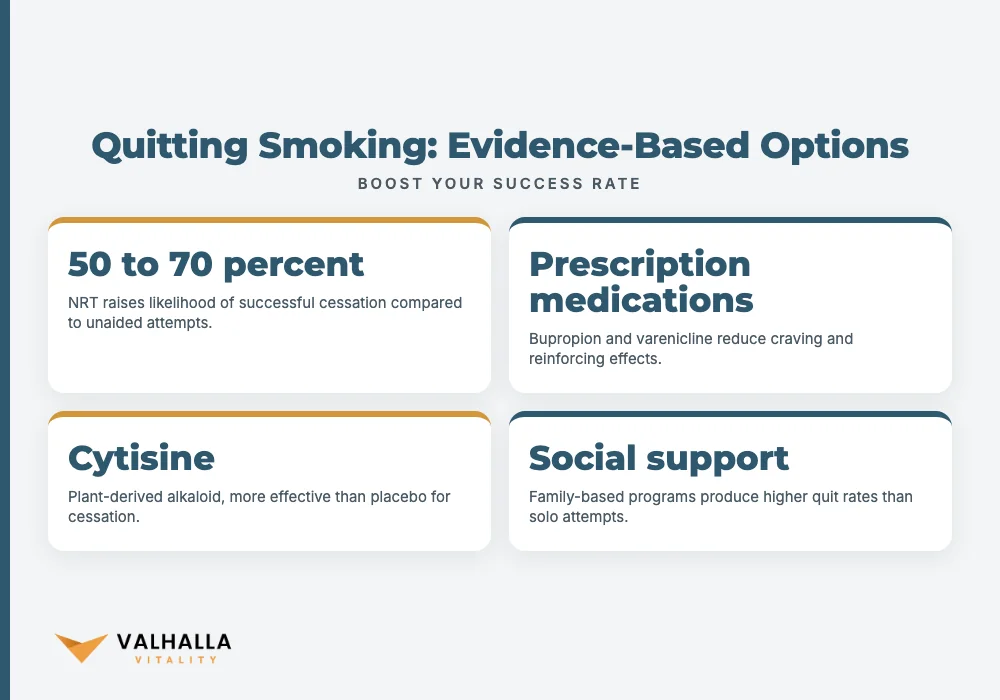
Nicotine replacement therapy (NRT) is the most widely available approach. Patches, gum, lozenges, and nasal sprays deliver controlled nicotine without the thousands of toxic chemicals in cigarette smoke. NRT reduces withdrawal severity and blunts cravings during the most difficult early weeks. The WHO (2021) reported that NRT raises the likelihood of successful cessation by 50 to 70 percent compared to unaided attempts.
Prescription medications such as bupropion and varenicline work on brain receptors to reduce nicotine craving and diminish the reinforcing effect of smoking. A licensed provider determines which therapy is appropriate after reviewing your medical history, including any psychiatric background. Prescription cessation medications require clinical oversight.
Cytisine, a plant-derived alkaloid that acts on the same nicotine receptors, has been used for smoking cessation in several European countries for decades. A 2023 systematic review and meta-analysis published in Drug and Alcohol Dependence found cytisine to be significantly more effective than placebo for cessation (Ofori et al., 2023). Availability varies by country and state; a licensed provider can advise on whether it is accessible in your situation.
Social and family support amplifies the effect of any medication-based approach. A 2016 systematic review in BMC Family Practice found that family-based cessation support programs produced meaningfully higher quit rates than solo attempts across the studies reviewed (Hubbard et al., 2016). Structured programs through organizations such as the American Lung Association offer free, evidence-based resources for people who benefit from community support alongside medical treatment.
Combining behavioral support with NRT or medication consistently outperforms either approach used alone. How to quit smoking successfully almost always involves layering strategies rather than depending on a single method. The negative effects of smoking on long-term health make that investment of time and effort genuinely worthwhile.
Take the next step toward quitting
A licensed provider can review your health history and help identify the cessation approach that fits your situation. Book Your Consultation to start the conversation.
FAQ
What are the most harmful effects of smoking on the body?
Smoking causes lung cancer, COPD, heart disease, and stroke, and raises the risk of at least a dozen additional cancer types. According to the WHO (2021), tobacco accounts for roughly one in three cancer deaths globally. Damage accumulates across organ systems and compounds with duration and intensity of use.
How does smoking affect mental health?
Smoking is associated with higher rates of anxiety, depression, and serious psychiatric conditions including schizophrenia and PTSD, according to the Mental Health Foundation (2021). Nicotine temporarily relieves withdrawal-related tension, which creates a reinforcing cycle that worsens baseline mood over time.
Can smoking cause hormonal imbalances?
Yes. Smoking has been associated with lower testosterone in men, earlier menopause in women, and disrupted cortisol signaling in both sexes. These hormonal changes affect energy, fertility, bone density, and immune function. A licensed provider can evaluate hormonal status through lab testing.
Is vaping safer than cigarettes?
No. E-cigarettes contain diacetyl, heavy metals, and volatile organic compounds, according to the CDC (2020), and the nicotine is equally addictive. Vaping avoids combustion products but introduces its own documented toxic exposures and poses particular risk to developing brains in young people.
What happens to your body when you quit smoking?
Blood oxygen levels improve within hours of stopping. Circulation and lung function recover over weeks and months. Long-term, the excess risk of cancer and heart disease decreases significantly, according to the WHO (2021). Quitting at any age reduces risk, with earlier cessation producing the largest overall health gains.
Sources
- World Health Organization (2021). Tobacco. WHO. WHO.int
- National Cancer Institute (2020). Cigarette Smoking. NCI. cancer.gov
- American Cancer Society (2020). How Tobacco Smoke Causes Disease. Surgeon General's Report. surgeongeneral.gov
- Mental Health Foundation (2021). Smoking and Mental Health. MHF. mentalhealth.org.uk
- Centers for Disease Control and Prevention (2020). Electronic Cigarettes. CDC. cdc.gov
- U.S. Department of Health and Human Services (2020). E-Cigarettes. HHS. hhs.gov
- Stoop TF et al. (2025). Pancreatic cancer. Lancet. PubMed
- Ofori S et al. (2023). Cytisine for smoking cessation: A systematic review and meta-analysis. Drug and Alcohol Dependence. PubMed
- Hubbard G et al. (2016). A systematic review and narrative summary of family-based smoking cessation interventions to help adults quit smoking. BMC Family Practice. PubMed