The following blog post is for entertainment and informational purposes only. It is not intended to provide medical advice or diagnosis. Please consult your doctor before making any health-related decisions.
A workout partner is one of the most effective tools for building lasting exercise consistency. Research from the International Journal of Sport Psychology shows that people who train with a companion are more likely to stick to their routine than those who go alone (Matsudo et al., 2002). Consistency matters more than any single session. Whether your aim is building strength, managing weight, or improving gym performance, training alongside the right person delivers advantages that solo effort rarely matches.
What are the benefits of having a gym buddy?
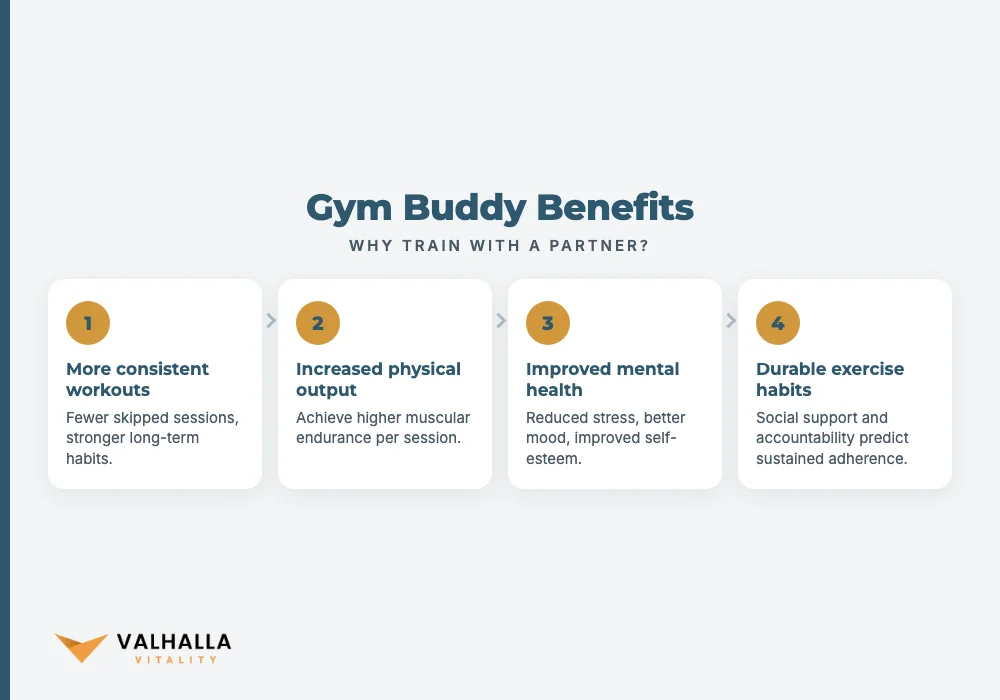
The gym partner benefits span accountability, physical output, and mental wellbeing. Each reinforces the others.
| Category | What changes | Research basis |
|---|---|---|
| Adherence | Fewer skipped sessions, stronger long-term habits | Matsudo et al. (2002) |
| Physical output | Higher muscular endurance per session | Ratamess et al. (2011) |
| Mental health | Reduced stress, better mood, improved self-esteem | Focht & Hausenblas (2010) |
| Behavioral change | More durable exercise habits over time | Lai et al. (2017) |
A 2011 study in the Journal of Sports Science and Medicine found that people training with a workout partner achieved significantly higher muscular endurance than those who trained alone (Ratamess et al., 2011). The mechanism is simple. Social observation raises effort. You push past the point where you would normally stop, complete the last rep, and reach for the heavier weight.
Partner training motivation also operates on a mood dimension. A 2010 study in the Journal of Sport and Exercise Psychology found that exercising alongside another person reduces stress and boosts self-esteem (Focht & Hausenblas, 2010). That shift makes the gym feel less like an obligation and more like a shared pursuit. Over months, that distinction matters more than any single workout.
Exercise accountability is the connective tissue. A 2017 scoping review in the American Journal of Physical Medicine & Rehabilitation identified social support and behavioral accountability among the strongest predictors of sustained exercise adherence in adults (Lai et al., 2017). A gym buddy delivers that support automatically. Someone is counting on you.
Is working out with a partner better than working out alone?
For most people, yes. The transition from solo workouts to training with a friend is one of the most impactful changes a person can make for long-term adherence. The solo vs partner workout comparison is not about which approach burns more calories in a single session. It is about which one you actually maintain.
Alone, skipping a session costs you nothing socially. With a workout partner, it costs both people a planned appointment. That difference shifts behavior. Behavioral accountability is built directly into the structure of the partnership, which is why the research consistently identifies social support as a key adherence driver.
Solo training has real strengths. You control the pace, exercise selection, and rest periods without compromise. Some people concentrate better in quiet. Athletes on strict periodization programs may find a partner adds complexity rather than benefit.
For most people, though, the obstacle is not designing the perfect program. It is showing up. On that front, having a workout partner consistently wins.
What should you look for in a gym partner?
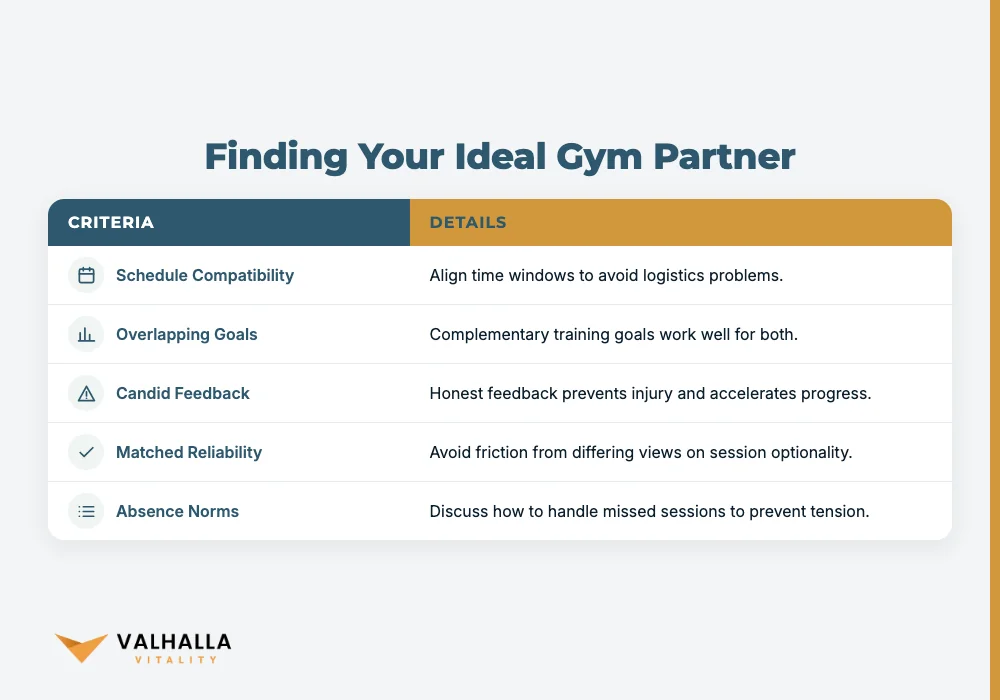
Look for schedule compatibility, goal alignment, and a willingness to give honest feedback. Not every workout partner fits. Gym buddy tips that focus only on enthusiasm miss the practical factors that determine whether a training arrangement lasts beyond the first month.
Criteria worth discussing before committing to a schedule:
- Compatible time windows: If your schedules align once a week at best, the arrangement will feel like a logistics problem rather than a benefit.
- Overlapping goals: Complementary training goals work well. Sharply divergent ones often lead to sessions that feel compromised for both people.
- Willingness to give candid feedback: A gym partner who tells you when your form slips is more valuable than one who only cheers. Honest feedback prevents injury and accelerates progress.
- Matched reliability: If one person treats sessions as optional and the other as fixed, the gap creates friction within weeks.
- Agreed norms for absences: Discuss in advance how each person handles a missed session. Low-drama protocols keep minor conflicts from becoming ongoing tension.
If your priority is pushing your performance ceiling, training with someone more experienced raises the bar. If consistent attendance is your main challenge, a partner at a similar fitness level tends to reduce friction and make sessions feel more equitable.
Some of these arrangements extend into recovery and nutrition habits. If both people are exploring evidence-based supplementation, working through topics like how plant-based anabolic compounds work can become part of the shared interest that strengthens mutual commitment.
How do you find a workout partner near you?
Start with the people already at your gym. Talk to someone who trains at similar times and follows a compatible format. Direct conversation is usually faster than any app.
Group fitness classes offer a natural matching environment. Everyone already shares a schedule and has some exercise accountability built in. That common ground makes introduction easier.
If your immediate network does not produce a good fit, local running clubs, community recreation centers, and fitness-focused social groups all connect people with overlapping goals. Dedicated apps exist for workout partner matching, though personal introductions tend to produce more reliable long-term arrangements.
When you identify a potential workout partner, suggest one trial session before agreeing to a regular schedule. A single workout removes pressure and gives both people honest data on compatibility before either commits.
How do you stay consistent with a workout partner?
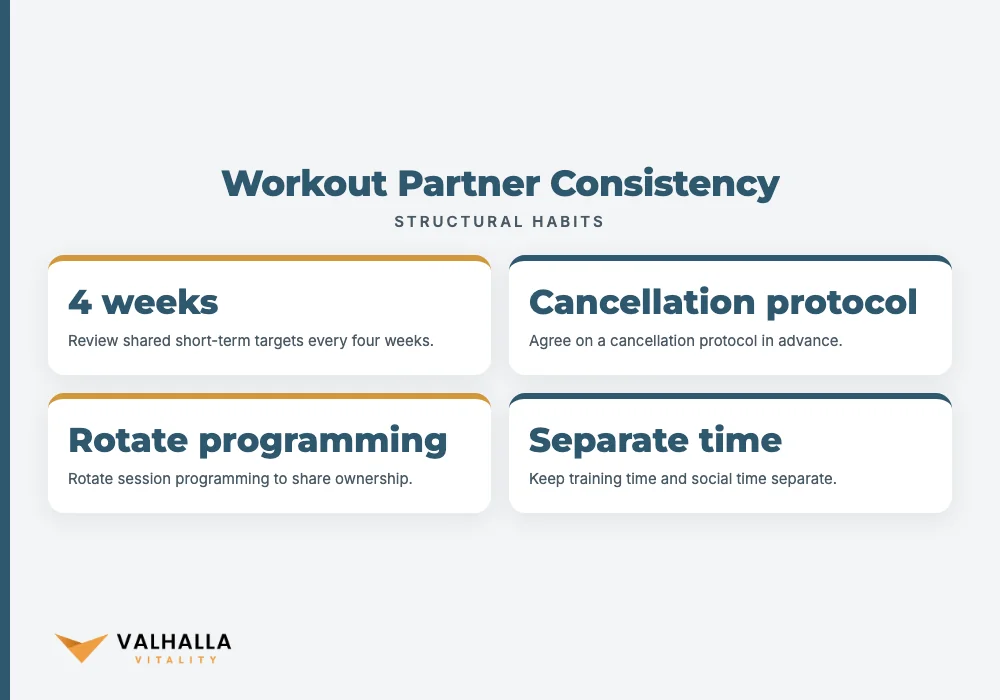
Stay consistent by setting shared targets, agreeing on a cancellation policy before you need one, and rotating who programs the sessions. Fitness buddy consistency is a practice, not a personality trait. Arrangements that start strong often lose momentum when novelty fades.
Structural habits that help:
- Set short-term shared targets and review them every four weeks.
- Agree on a cancellation protocol in advance, including what counts as a valid reason to reschedule. Then stick to it.
- Rotate session programming so both people share ownership of the plan.
- Keep training time and social time structurally separate. Long rest periods filled with conversation erode intensity.
If you are both working on building strength through systematic progression, tracking numbers together gives the partnership ongoing direction beyond habit alone. For broader health context that may affect your training capacity, Valhalla Vitality publishes evidence-based guides covering supplementation, hormone health, and recovery.
Ready to take your health further?
Book Your Consultation with a licensed provider who reviews your intake and determines what, if anything, is appropriate for your individual situation.
FAQ
Can a workout partner help prevent gym injuries?
A spotter directly reduces risk during heavy compound lifts, and a second person is more likely to catch form breakdowns before they cause strain. Partners also tend to hold each other accountable to proper warm-up and cool-down habits, which solo training often skips.
What if my workout partner cancels too often?
Address it directly after the second or third cancellation, before a pattern takes hold. Set a mutual expectation for reliability and agree on how each person communicates schedule changes. If repeated cancellations continue, restructuring from scheduled to occasional training may be the practical solution.
Does training with a gym buddy actually improve results?
Yes, when measured over time. Partners achieve higher muscular endurance per session (Ratamess et al., 2011) and are more likely to maintain their routine long-term (Matsudo et al., 2002). Consistent effort sustained over months drives fitness results, and a workout partner supports exactly that consistency.
Is a workout partner useful for experienced athletes?
Yes. Even experienced athletes benefit from social accountability and the performance increase that comes from training alongside another person. The motivational and adherence effects documented in the research apply across fitness levels, not only to beginners.
Sources
- Matsudo, S. M., Araújo, T., Matsudo, V. K., Andrade, D., & Ohira, T. (2002). Physical activity level and associated factors in adults from São Paulo, Brazil. International Journal of Sport Psychology, 33(2), 156–174.
- Ratamess, N. A., Faigenbaum, A. D., Kang, J., & Hoffman, J. R. (2011). The effects of partner versus self-resistance training on muscular endurance. Journal of Sports Science and Medicine, 10(3), 441–447.
- Focht, B. C., & Hausenblas, H. A. (2010). The impact of workout partners on exercise behavior: a self-determination theory perspective. Journal of Sport and Exercise Psychology, 32(5), 533–549.
- Lai, B., et al. (2017). Current Trends in Exercise Intervention Research, Technology, and Behavioral Change Strategies for People With Disabilities: A Scoping Review. American Journal of Physical Medicine & Rehabilitation. PubMed