
The following blog post is for entertainment and informational purposes only. It is not intended to provide medical advice or diagnosis. Please consult your doctor before making any health-related decisions.
Sermorelin is a GHRH peptide that stimulates the pituitary to produce more growth hormone. The core sermorelin benefits include better sleep, lean muscle growth, improved energy, and stronger skin collagen. It works through the body's natural hormonal axis rather than introducing synthetic GH. A licensed provider reviews bloodwork before confirming whether this GHRH peptide therapy is appropriate, and booking a consultation is how that starts.
What are the main benefits of sermorelin therapy?
Growth hormone influences many systems at once. That is why the range of reported sermorelin benefits is fairly broad, touching sleep, body composition, skin, metabolism, and cognition.
Sermorelin triggers the pituitary to release GH in pulses that mirror the body's natural circadian rhythm. The key areas where therapy may have an effect:
- Sleep quality: growth hormone secretion peaks during deep slow-wave sleep, and sermorelin may help restore that cycle as GH output declines with age
- Lean muscle mass: higher GH levels support protein synthesis and limit muscle breakdown, shifting body composition gradually toward more lean tissue
- Energy and cellular metabolism: restored GH output improves how efficiently cells extract usable energy from glucose and fatty acids
- Skin collagen: GH directly stimulates fibroblasts, the cells that produce collagen and elastin throughout skin tissue
- Cognitive clarity: GH receptors are distributed throughout the brain, and normalized GH levels may reduce mental fog and improve focus
- Body composition: lean muscle tissue has a higher resting metabolic rate than fat, so an increase in lean mass can support weight management alongside diet and exercise
Each of these sermorelin benefits connects back to one mechanism: restoring GH toward the range typical for a younger adult.
How sermorelin works as a GHRH peptide
Sermorelin mimics the structure of growth hormone-releasing hormone at the molecular level. It binds to GHRH receptors in the pituitary gland. The pituitary then releases growth hormone in controlled pulses, mirroring the body's natural secretion pattern rather than flooding the system.
This matters because direct GH injections bypass the natural feedback loop entirely. Over time, that bypass can suppress the pituitary's own function. GHRH peptide therapy keeps the pituitary active. The body retains its ability to adjust GH output based on sleep depth, nutritional state, and stress. That self-regulation prevents levels from rising above a physiological range.
One practical consequence: a licensed provider determines the approach after reviewing baseline IGF-1 levels and a full hormonal panel. What it takes to restore GH to a healthy range differs from person to person. Lab results and individual history drive that decision, not a standard protocol applied uniformly across all patients.
Does sermorelin improve sleep quality?
Yes. Sleep and growth hormone are deeply connected. The largest GH pulses occur during the first cycles of deep slow-wave sleep each night. When GH production declines with age, slow-wave sleep often diminishes at the same time, reducing the hormonal signal that would otherwise reinforce it.
Sermorelin sleep improvement tends to work in both directions. Stimulating more GH release may help deepen slow-wave sleep stages, which in turn supports more GH secretion the following night. Users consistently report waking more rested, falling asleep faster, and experiencing fewer nighttime interruptions as early effects, often within four to eight weeks.
The connection between sleep and hormonal health extends beyond GH alone. Poor sleep elevates cortisol, reduces insulin sensitivity, and compounds fatigue. For a broader look at how sleep and hormone levels interact, that relationship shapes recovery across the full hormonal network, not just growth hormone.
Sermorelin sleep improvement is frequently the first benefit people notice. This timing matters because sleep quality affects virtually every downstream outcome: energy, mood, muscle recovery, and cognitive performance. Improving sleep is not just one of the sermorelin benefits; it is often the foundation from which the others develop. Better sleep also makes the hormonal feedback loops that sermorelin supports more responsive, amplifying the downstream results.
Can sermorelin help increase muscle mass?
Yes, though the effect is gradual and works best alongside consistent resistance training and adequate protein. Growth hormone promotes protein synthesis, the process that builds muscle from dietary amino acids. It also limits muscle protein breakdown. The net result, over months, is a gradual shift toward more lean tissue.
Sermorelin lean muscle results develop slowly. Most people report meaningful body composition changes after three to six months of consistent therapy combined with regular exercise and sufficient protein. This is a hormonal correction that makes the conditions for muscle adaptation more favorable.
A secondary effect matters for long-term body composition. Muscle tissue burns more calories at rest than fat tissue. As sermorelin lean muscle accumulates, resting metabolic rate tends to rise. That metabolic shift can gradually improve body composition even on days without intense training, reducing the typical pattern where gains plateau despite continued effort.
The sermorelin benefits for lean muscle are most relevant for people already doing the work: training consistently, sleeping adequately, eating enough protein, and still not recovering or progressing in proportion to that effort. When incomplete recovery, early fatigue, and slow muscle response persist despite solid habits, GH insufficiency is a reasonable place to investigate.
Sermorelin energy boost and metabolic support
Growth hormone plays a direct role in cellular metabolism. Specifically, it determines how efficiently cells extract usable energy from glucose and fatty acids. When GH output is chronically low, that efficiency drops. The result is fatigue not explained by sleep debt or overtraining alone.
A sermorelin energy boost often looks less like a surge and more like a gradual removal of a persistent drag. People describe it as: tasks that felt heavy start to feel manageable. Recovery between workouts shortens. The pronounced afternoon slump fades. Physical and cognitive fatigue both ease as GH levels normalize.
The overlap between a sermorelin energy boost and improved sleep is not incidental. Sleep deprivation impairs GH secretion, which impairs cellular metabolism, which worsens next-day fatigue. Sermorelin can interrupt that cycle from the hormonal side.
For people who have ruled out other common causes of persistent fatigue, including thyroid dysfunction, iron deficiency, and inadequate vitamin D, normalizing GH through GHRH peptide therapy may address what remains. The energy-related sermorelin benefits are often what prompts people to investigate hormonal health more closely. For context on how hormone therapy approaches energy and vitality, there is useful comparison between different hormonal interventions.
Sermorelin skin collagen and appearance
Collagen is the structural protein that gives skin its firmness, thickness, and elasticity. Its production declines with age, partly in parallel with GH. The connection is direct: GH stimulates fibroblast activity, and fibroblasts produce collagen and elastin in skin.
The sermorelin benefits for skin collagen accumulate gradually. What people typically notice first is a change in texture rather than appearance. Skin feels less thin and papery. Fine lines may soften. Tone becomes more consistent. These changes align with what more fibroblast activity and higher collagen synthesis would produce over three to six months.
The improvement in radiance that some users describe alongside sermorelin skin collagen changes likely reflects better circulation, faster cellular turnover, and improved hydration at the skin level, all of which higher GH activity supports. These are modest, gradual changes. They are not permanent without continued therapy, but they are consistent with the biology.
One broader point: collagen is not only a skin protein. It is also the main structural component of tendons, ligaments, and cartilage. Some people on sermorelin therapy report improvements in joint comfort alongside the skin changes. Research on this application specifically remains limited, but the mechanism is plausible given collagen's role throughout connective tissue.
Sermorelin cognitive function benefits
Growth hormone receptors are present throughout the brain. GH and its primary downstream mediator, IGF-1, contribute to neuronal maintenance, synaptic function, and the brain's management of oxidative stress. The sermorelin cognitive function improvements reported by users, sharper focus, faster recall, and reduced mental fog, align with what GH research indicates about brain health.
Cognitive changes from GH insufficiency are not always neurological in origin. Poor sleep reduces cognitive performance directly. Low GH reduces the brain's overnight repair capacity. The sermorelin benefits for cognitive function likely reflect a compound correction: better sleep leads to better overnight neural repair, and normalized GH levels support brain cell maintenance directly.
For a fuller look at how hormonal health connects to brain function, there is relevant material on cognitive and emotional wellness.
An important distinction: sermorelin is not a cognitive enhancer in the conventional sense. It does not sharpen thinking in people with normal hormonal function. The cognitive sermorelin benefits apply specifically in the context of GH insufficiency, where restoring normal levels removes a functional limitation rather than pushing performance above baseline.
Sermorelin benefits timeline: how long results take
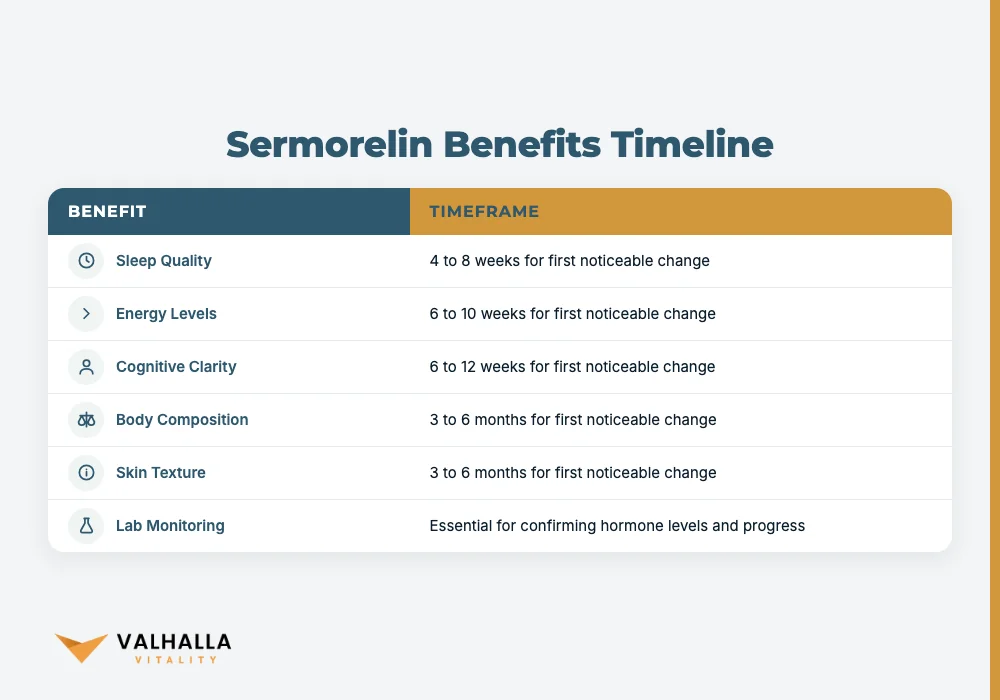
Sermorelin therapy results appear on different timelines depending on which system is affected. The table below reflects general patterns from clinical observation, not assured outcomes. Individual results depend on baseline GH levels, lifestyle, age, and consistency.
| Benefit area | Typical time to first noticeable change |
|---|---|
| Sleep quality | 4 to 8 weeks |
| Energy levels | 6 to 10 weeks |
| Cognitive clarity | 6 to 12 weeks |
| Body composition | 3 to 6 months |
| Skin texture | 3 to 6 months |
Sleep and energy tend to respond earliest because they react to any increase in GH pulsatility, even modest ones. Body composition and skin require sustained higher GH over enough time for protein synthesis and collagen production to visibly accumulate. Cognitive clarity falls between the two, depending partly on sleep improvement and partly on direct neural support.
What stays constant regardless of timeline: the value of lab monitoring. Without baseline and follow-up IGF-1 measurements, there is no objective way to confirm hormone levels are shifting or that sermorelin therapy results are tracking in the right direction. A provider who checks labs at regular intervals can identify early whether the protocol needs adjustment rather than waiting months before changing course.
Understanding the timeline also supports commitment. Many people who stop early do so before the slower-responding sermorelin benefits have had time to emerge. Consistency through the first three to six months, combined with provider oversight, is what distinguishes a completed therapeutic trial from an incomplete one.
Is sermorelin safe for anti-aging use?
Sermorelin has an established safety profile that distinguishes it from synthetic growth hormone therapy. Because it stimulates the pituitary to produce GH rather than supplying it externally, it avoids the supra-physiologic levels and feedback suppression that direct GH therapy can produce. The pituitary's own regulatory mechanisms remain active, which limits overproduction.
The most commonly reported side effects are mild and local: injection-site redness, itching, or discomfort at the administration site. Some people experience temporary fluid retention in the early weeks as GH levels adjust. Both typically resolve without intervention.
Who is not a candidate matters as much as who is. People with active malignancies, pituitary tumors, or known hypersensitivity to the compound are not appropriate candidates. The therapy requires a licensed provider's evaluation before prescribing and ongoing monitoring throughout treatment. Changes in body weight, blood pressure, blood glucose, and IGF-1 all warrant periodic review.
For anti-aging purposes, the clinical goal is to restore GH to the physiological range typical for a younger adult, not to push levels above that range. Supraphysiologic GH carries measurable risks, including joint pain, insulin resistance, and increased cardiovascular stress. Provider oversight and regular lab work are what keep therapy within the range where the sermorelin benefits outweigh the risks.
Availability varies by state.
What to expect from the provider evaluation
The evaluation for sermorelin typically begins with bloodwork measuring IGF-1, the downstream marker for GH activity, alongside a broader hormonal panel. The provider also screens for contraindications and considers whether lifestyle factors such as sleep disruption, nutritional deficiency, or thyroid dysfunction explain the symptoms independently before recommending a hormonal intervention.
This step is substantive, not procedural. Many symptoms associated with GH decline overlap substantially with other conditions. Persistent fatigue, reduced lean mass, disrupted sleep, and mental fog all appear in thyroid disorders, low testosterone, and several nutritional deficiencies. A careful intake reduces the chance of treating the wrong underlying cause.
After the initial prescription, a provider monitors IGF-1 and relevant markers at regular intervals. If levels are not shifting as expected, the protocol is adjusted before months pass without progress. This is what ongoing oversight looks like in practice, and it is the difference between therapy that tracks toward the anticipated sermorelin benefits and one that is recalibrated when results are absent. Valhalla Vitality structures the process this way: licensed provider review, compounded pharmacy fulfillment, and provider approval within 24 business hours of order placement.
Take the next step
If the sermorelin benefits described here align with the symptoms you are managing, the right starting point is a licensed provider review.
FAQ
What are the main sermorelin benefits?
Sermorelin may support improved sleep quality, more lean muscle mass, sustained energy, sharper cognitive function, and better skin collagen production. These effects stem from increased pituitary growth hormone output. Results vary based on baseline GH levels, age, lifestyle, and consistency with therapy.
How long does sermorelin take to show results?
Sleep and energy improvements are often the first to emerge, typically within four to ten weeks. Body composition and skin changes generally require three to six months of consistent therapy to become noticeable. Lab monitoring is the most reliable way to confirm that hormone levels are shifting in the right direction.
Does sermorelin improve sleep quality?
Yes. Growth hormone secretion is closely tied to deep slow-wave sleep stages, and restoring GH levels may help deepen that sleep and reduce nighttime waking. Sermorelin sleep improvement is commonly reported within the first two months of therapy and often reinforces other sermorelin benefits by improving recovery overnight.
Is sermorelin the same as growth hormone therapy?
No. Sermorelin is a GHRH peptide that stimulates the pituitary to produce its own growth hormone naturally. Direct GH therapy introduces synthetic growth hormone externally and can suppress the pituitary's regulatory function over time. The two approaches differ in mechanism, risk profile, and long-term effects on pituitary health.
Who is a good candidate for sermorelin therapy?
Adults with symptoms consistent with growth hormone insufficiency, such as disrupted sleep, persistent fatigue, reduced lean muscle, or cognitive fog, may be evaluated for this therapy. A licensed provider determines eligibility after reviewing labs and intake history. Availability varies by state.
You May Also Like
 Sermorelin
 for Muscle Growth: What the Research Shows
Sermorelin for muscle growth may help build lean mass and speed recovery. Learn how GH stimulation works and what providers review before prescribing.
November 26, 2026 ETRead more → Sermorelin
 Dosage Anti Aging: How Protocols Are Set
Sermorelin dosage anti aging is set by a licensed provider after labs. Learn how the protocol, injection frequency, and adjustments work.
November 26, 2026 ETRead more → Sermorelin
 Weight Loss: Fat, Muscle, and Metabolism
Sermorelin weight loss therapy may support fat reduction, lean muscle mass, and metabolic function through natural growth hormone stimulation.
November 19, 2026 ETRead more →