
The following blog post is for entertainment and informational purposes only. It is not intended to provide medical advice or diagnosis. Please consult your doctor before making any health-related decisions.
Questions about enclomiphene FDA approval 2026 have one clear answer: no standalone FDA approval has been granted for this compound. It remains available in the US through licensed compounding pharmacies. Access requires a licensed provider to review a patient's medical history, symptoms, and lab results before prescribing. People researching enclomiphene therapy often find that off-label compounded prescribing is a legal, provider-supervised pathway supported by a growing clinical evidence base. The regulatory pathway and the evidence base are two separate discussions. Both deserve clarity.
Enclomiphene FDA approval 2026: what the regulatory record shows
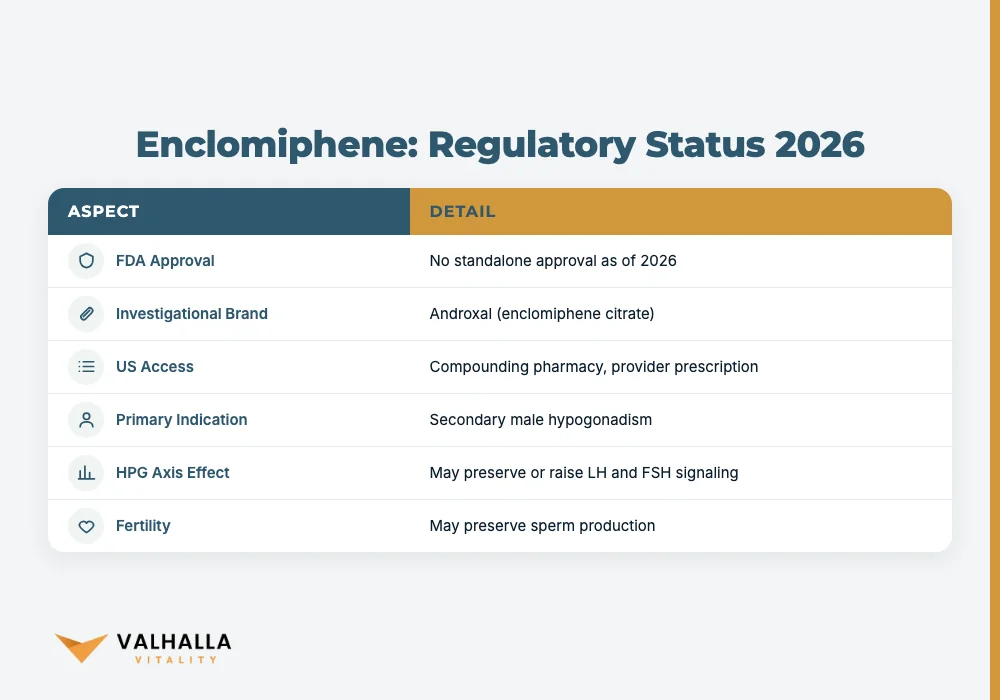
No. Enclomiphene does not hold a standalone FDA approval for any indication as of 2026. The compound, known in clinical investigations under the brand name Androxal, went through FDA regulatory review but did not receive approval for commercial use. That is androxal approval status in brief. Access in the US has since moved to compounded enclomiphene citrate, prescribed off-label by licensed providers after reviewing individual labs and health history.
Understanding enclomiphene FDA approval 2026 also means understanding enclomiphene availability US-wide. Access depends on state-by-state compounding pharmacy rules and an active prescription from a licensed provider. Availability varies by state. There is no over-the-counter path.
The table below summarizes where enclomiphene stands across the most common dimensions patients ask about.
| Dimension | Detail |
|---|---|
| FDA approval status | No standalone approval as of 2026 |
| Brand name in investigations | Androxal (enclomiphene citrate) |
| US access route | Compounding pharmacy, provider prescription required |
| Primary studied indication | Secondary male hypogonadism |
| Effect on HPG axis | May preserve or raise LH and FSH signaling |
| Fertility consideration | May preserve sperm production vs. exogenous testosterone |
| Europe availability | Not broadly approved; rules vary by country |
Enclomiphene for hypogonadism: how it differs from exogenous testosterone
In cases where testosterone is low because of insufficient HPG-axis signaling rather than testicular failure, enclomiphene for hypogonadism addresses the problem at a different level than testosterone replacement. Rather than supplying testosterone directly, enclomiphene may stimulate the pituitary to release more luteinizing hormone and follicle-stimulating hormone. Those gonadotropins then signal the testes to produce testosterone on their own.
This matters clinically. Exogenous testosterone suppresses the HPG axis, which reduces LH and FSH. Gonadotropin levels typically drop, and sperm production often follows. Enclomiphene, by working upstream, may leave that axis intact or even strengthen it, and that distinction shapes much of the current enclomiphene citrate research focus and explains why the compound draws specific interest from men with fertility goals.
How does enclomiphene compare to clomid for low testosterone?
Enclomiphene and clomiphene (commonly called clomid) come from the same molecular family. Clomiphene is a mixture of two isomers: enclomiphene (the trans-isomer) and zuclomiphene (the cis-isomer). The difference matters. Enclomiphene is the component thought to drive the testosterone-supporting effect by blocking estrogen receptors in the hypothalamus, which triggers LH and FSH release. Zuclomiphene, by contrast, has a longer half-life and may accumulate during prolonged use, raising questions about sustained estrogenic activity.
That molecular distinction shapes the enclomiphene vs clomid testosterone discussion in clinical settings. A 2025 systematic review and meta-analysis by Hohl et al. in Archives of Endocrinology and Metabolism gathered data from randomized controlled trials comparing both compounds in men with hypogonadism, helping clarify how each performs under controlled conditions. For a detailed clinical comparison of enclomiphene and clomid in men's hormone health, the isomer difference is the practical starting point. Both compounds still require provider supervision and individualized monitoring.
Can enclomiphene preserve fertility while raising testosterone?
Yes, and enclomiphene fertility preservation is one of the main reasons the compound draws clinical attention that exogenous testosterone therapy does not. Exogenous testosterone suppresses the hypothalamic-pituitary-gonadal axis, reducing LH, FSH, and, in many cases, sperm production. The effect can persist for months after stopping therapy. Enclomiphene works by a different mechanism entirely.
By blocking estrogen receptors in the hypothalamus, enclomiphene may keep gonadotropin release active, which means the testes continue receiving the signal to produce both testosterone and sperm. The 2016 expert review by Rodriguez et al. in Expert Opinion on Pharmacotherapy examined this mechanism in the context of secondary male hypogonadism and established the pharmacological basis for this approach.
Individual responses vary. Sperm count and motility depend on more factors than LH and FSH alone. A licensed provider determines whether a therapy is appropriate after reviewing labs, fertility goals, and health history. For men researching how enclomiphene may affect sperm count and production, that provider review is the practical first step.
Is enclomiphene available in Europe in 2026?
Enclomiphene is not broadly approved across European markets as of 2026. Drug approvals in Europe fall under the European Medicines Agency, which operates independently from the FDA. Because enclomiphene did not gain FDA approval in the US, there was no parallel approval for European regulators to reference. Access in individual European countries, where it exists at all, depends on country-specific compounding rules or off-label prescribing frameworks. Those rules vary significantly by country.
US residents have a more defined path. Enclomiphene availability US-wide is anchored in the 503A and 503B compounding pharmacy framework, with a licensed provider's prescription required after a full medical intake. Availability varies by state, and telehealth platforms have expanded access in states where providers hold active licenses.
What the current research base shows
The evidence for enclomiphene centers on secondary hypogonadism: cases where testosterone is low because HPG-axis signaling is insufficient, not because testicular function is lost. Earlier clinical studies suggested enclomiphene may raise testosterone while preserving or improving gonadotropin levels. That is a different profile from what exogenous testosterone typically produces.
The enclomiphene citrate research base has grown through systematic review. A 2025 meta-analysis by Hohl et al. in Archives of Endocrinology and Metabolism synthesized data from randomized controlled trials comparing both clomiphene and enclomiphene in men with hypogonadism, lending structure to a field that previously relied on smaller individual studies. For readers following enclomiphene FDA approval 2026 updates, the most meaningful signal in 2026 comes from that review-level synthesis rather than from new regulatory announcements.
Gaps persist. Long-term outcomes beyond standard trial windows are not fully characterized. Lab improvements do not always map to symptom improvements; fatigue, libido, body composition, and recovery are shaped by sleep, stress, metabolic health, and medications, not testosterone numbers alone. The preclinical and clinical research behind the current case for enclomiphene continues to develop. Providers at platforms like Valhalla Vitality apply this evidence through individualized intake processes that weigh labs, symptoms, and goals before any prescribing decision.
Get a provider review
If you want to understand whether enclomiphene may be right for your situation, the next step is a provider-led review of your labs and health history, not a headline scan. Book Your Consultation to get started.
FAQ
Does enclomiphene have FDA approval in 2026?
No. As of 2026, enclomiphene does not hold a standalone FDA approval for any indication. It is available in the US as a compounded medication through licensed pharmacies, prescribed only after a licensed provider reviews intake and labs.
What is Androxal and what happened with its FDA approval?
Androxal is a brand name for enclomiphene citrate used in clinical investigations. It went through FDA regulatory review but did not receive approval for commercial use. Compounded enclomiphene has since become the primary access pathway in the US.
How does enclomiphene compare to clomid for testosterone support?
Both compounds block estrogen receptors in the hypothalamus to raise LH and FSH, but enclomiphene is the isolated trans-isomer while clomid is a mixture that also contains the cis-isomer zuclomiphene. That structural difference may result in a cleaner hormonal profile, though both require provider supervision and ongoing monitoring.
Can enclomiphene preserve fertility while raising testosterone?
Enclomiphene may preserve LH and FSH signaling, which keeps the reproductive axis active and supports sperm production. This is the main reason it draws interest from men who want testosterone support while keeping fertility options open. A licensed provider reviews labs and health history before determining whether it is appropriate.
Is enclomiphene available to men in Europe?
Enclomiphene is not broadly approved in European markets as of 2026. European regulatory bodies operate independently from the FDA, and country-specific rules for compounding and off-label prescribing vary significantly. US access follows state-by-state compounding pharmacy rules.
Sources
- Hohl A et al. (2025). Clomiphene or enclomiphene citrate for the treatment of male hypogonadism: a systematic review and meta-analysis of randomized controlled trials. Archives of Endocrinology and Metabolism. PubMed
- Rodriguez KM et al. (2016). Enclomiphene citrate for the treatment of secondary male hypogonadism. Expert Opinion on Pharmacotherapy. PubMed
You May Also Like
 Enclomiphene
Enclomiphene Mood Swings: Causes and What to Expect
Enclomiphene mood swings, depression, anxiety, and sleep issues explained. Learn what causes mood changes and how provider oversight helps.
October 20, 2026 ETRead more → Enclomiphene
Enclomiphene and Pregnenolone: Men's Hormone Stack Guide
Enclomiphene and pregnenolone may support testosterone and hormonal balance in men. Explore how this hormone stack works and when to consider it.
October 20, 2026 ETRead more → Enclomiphene
Enclomiphene Dosage Bodybuilding: What Men Need to Know
Enclomiphene dosage bodybuilding: how this SERM raises testosterone, supports muscle and fat loss, and what a provider reviews before prescribing.
October 19, 2026 ETRead more →