
The following blog post is for entertainment and informational purposes only. It is not intended to provide medical advice or diagnosis. Please consult your doctor before making any health-related decisions.
Enclomiphene vision side effects include eye floaters, blurry vision, light sensitivity, and in rare cases more significant changes to visual acuity that require stopping therapy without delay. These are not the most frequently reported complaints among men using this compound. They carry more clinical weight than most other adverse effects. If you are taking enclomiphene treatment and notice any change in your vision, contact your provider the same day rather than waiting for your next scheduled appointment.
Enclomiphene eye problems: a practical overview
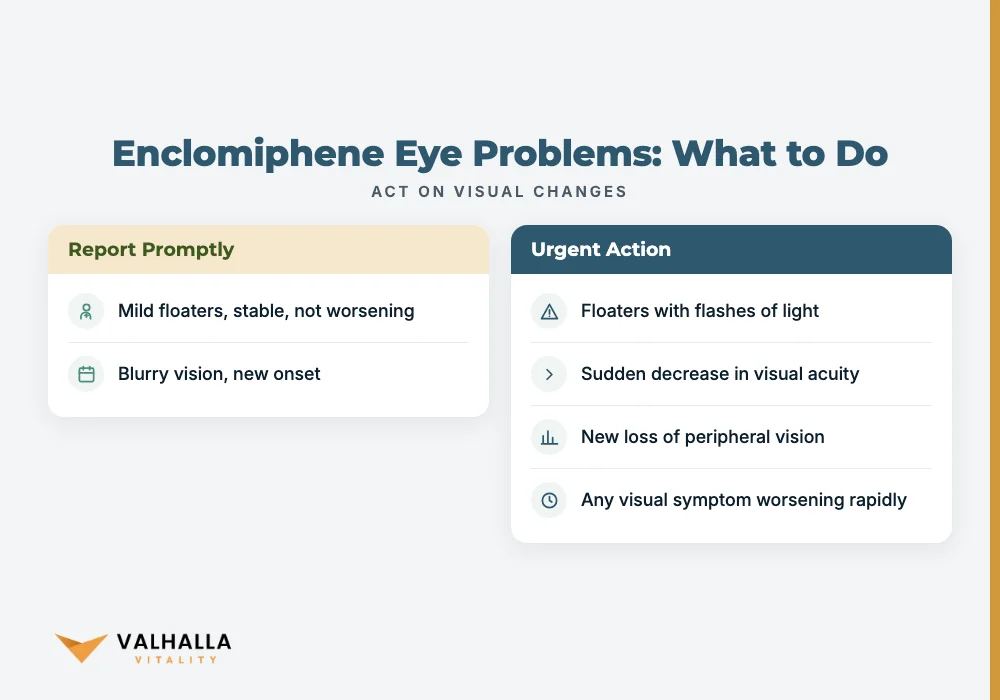
Not every floater is urgent. Not every urgent symptom looks like a floater. Before the mechanism and clinical details, here is a reference for the full range of enclomiphene eye problems and what each presentation requires.
| Symptom | Urgency level | Recommended action |
|---|---|---|
| Mild floaters, stable, not worsening | Report promptly | Contact provider immediately; do not self-manage |
| Blurry vision, new onset | Report same day | Provider evaluates and advises |
| Floaters combined with flashes of light | Urgent | Stop therapy; ophthalmology same day or next day |
| Sudden decrease in visual acuity | Urgent | Stop therapy; ophthalmology same day or next day |
| New, persistent loss of peripheral vision | Urgent | Stop therapy; ophthalmology same day or next day |
| Any visual symptom worsening rapidly | Urgent | Stop therapy; ophthalmology same day or next day |
The guiding principle: no visual symptom during enclomiphene therapy is too minor to report to your provider.
The class-level connection: where the risk comes from
Enclomiphene is the trans-isomer of clomiphene citrate. Visual side effects, including blurry vision, eye floaters, light sensitivity, and in rare cases more severe disturbances, have been part of clomiphene's established side effect profile for decades. Enclomiphene inherits this class-level risk.
Enclomiphene is not clomiphene. It contains only the trans-isomer, while clomiphene combines both the trans (enclomiphene) and cis (zuclomiphene) isomers. That pharmacological distinction may affect how visual side effects present and how long they persist after stopping the drug. The shared receptor mechanism means, however, that visual symptoms cannot be dismissed as coincidental when men taking enclomiphene report them. The mechanistic overlap is real.
When a man on enclomiphene reports visual disturbances, the clinical response does not start from zero. Decades of experience with clomiphene-class drugs provide a working framework for evaluation and response. That history is part of why enclomiphene ocular side effects receive careful clinical attention even though they are relatively uncommon.
Why does enclomiphene affect eyesight?
Enclomiphene works as a selective estrogen receptor modulator, or SERM. Its primary action is in the hypothalamus, where it blocks estrogen receptors and prompts the hypothalamic-pituitary axis to release more GnRH, LH, and FSH. That signaling cascade drives testosterone production. The visual pathway is not the intended target.
The issue is systemic distribution. The retina and neural tissue involved in visual processing both contain estrogen receptors. When a SERM circulates through the body, it reaches those receptors as well. In some individuals, that contact disrupts how visual signals are processed, producing enclomiphene eye floaters, phosphenes, blurry vision, or reduced contrast sensitivity.
Contrast sensitivity deserves a specific mention. It refers to the ability to distinguish between shades of gray and detect edges in low-contrast environments. Reduced contrast sensitivity can make driving at dusk harder or make text on a gray background difficult to read, even when measured visual acuity tests as normal. A standard vision check does not assess contrast sensitivity. A dedicated ophthalmologic examination is required.
Think of it this way. The receptor-blocking action that allows enclomiphene to work in the hypothalamus does not stay localized there. Estrogen receptors exist throughout the body, and the visual pathway is one tissue where their modulation can produce noticeable effects. In most cases this is not structural damage. It is a disruption of normal signaling.
Why some men experience enclomiphene blurry vision or floaters while the majority do not remains incompletely explained. Variability in estrogen receptor expression, differences in how the drug distributes to ocular tissues, and individual baseline visual health all likely contribute. No test currently predicts who is at elevated risk before therapy begins.
Does enclomiphene cause eye floaters?
Yes. Enclomiphene can cause eye floaters in some users. The mechanism, estrogen receptor activity in the retina and visual pathway, is not incidental. It is the same class-level effect documented with clomiphene citrate over years of clinical use.
Enclomiphene eye floaters are typically described as floating spots, specks, or cobweb-like shapes visible in the field of vision. They tend to be most noticeable against bright or uniform backgrounds like a white screen or open sky. Some men report a persistent soft blur alongside the floaters. Others describe disturbances that vary in intensity throughout the day or worsen when fatigued.
Timing is unpredictable. Some men notice enclomiphene eye floaters within the first few weeks of treatment. Others develop them later in the course of therapy. There is no established predictive window. Sustained attention to visual function matters throughout treatment, not only at the start.
The absence of floaters early in treatment does not mean the risk has passed. It means the risk has not yet materialized. Ongoing awareness is part of responsible treatment management.
What enclomiphene eye floaters typically feel like
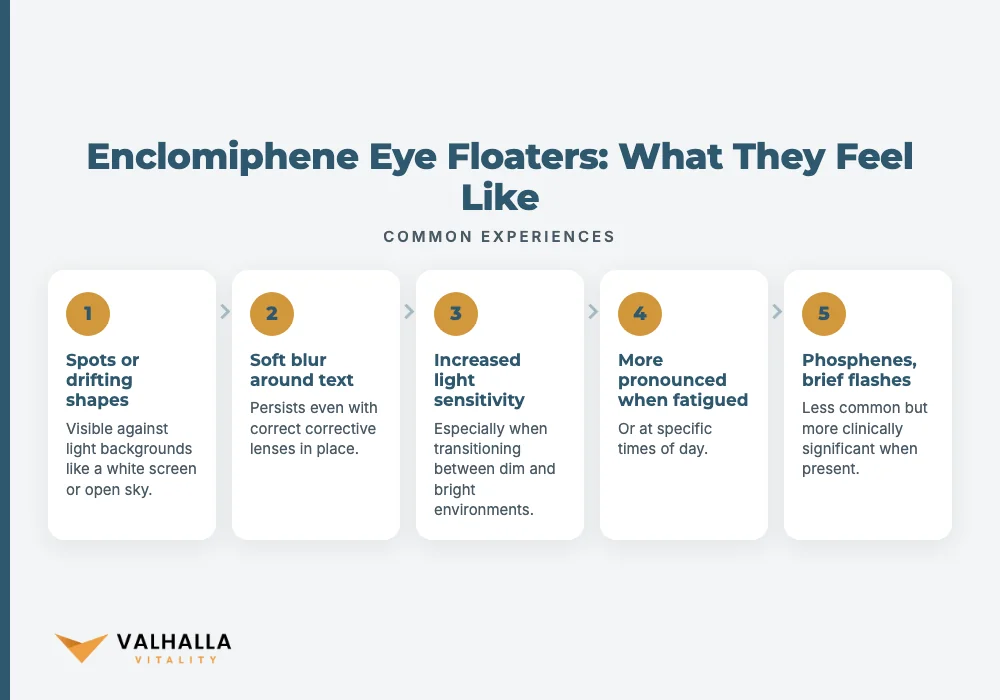
Men who report enclomiphene eye issues describe a range of experiences. Common accounts include:
- Spots, specks, or translucent drifting shapes in the visual field, most visible against light backgrounds such as a white screen or open sky
- A soft blur around text or objects that persists even with correct corrective lenses in place
- Increased sensitivity to light, particularly when transitioning between dim and bright environments
- Disturbances that are more pronounced when fatigued or at specific times of day
- Phosphenes, brief arc-like flashes of light, which are less common but more clinically significant when present
One clinical distinction matters: whether symptoms are in one eye or both. Asymmetric floaters, present in one eye but not the other, particularly when paired with flashes of light, can indicate a different and more urgent pathology than symmetric bilateral floaters. Report any asymmetric presentation the same day it appears.
Documenting the symptom precisely gives your provider the information needed for an accurate assessment. Note when it started, which eye or eyes are involved, whether it is stable or changing, and any other visual changes occurring at the same time.
How common are vision side effects with enclomiphene?
Enclomiphene vision side effects are reported less frequently than headaches, mood changes, or mild testicular discomfort in men using this therapy. They appear in a minority of users. The exact incidence for enclomiphene specifically is not well-established in the published literature, because the compound lacks regulatory approval and large-scale, long-term safety surveillance data does not exist.
The clomiphene literature provides a general framework. Visual disturbances occur in a minority of users, and their severity when they do occur spans a wide range from trivially annoying to clinically significant. Most men taking enclomiphene will not develop meaningful enclomiphene eye issues. Uncommon, however, does not mean negligible. These symptoms can progress if not addressed promptly, and that clinical reality is what distinguishes enclomiphene ocular side effects from more self-limiting complaints like headache or temporary mood shifts.
For context on where visual symptoms fit within the documented range of adverse effects from this compound, how enclomiphene's safety profile is assessed in supervised therapy covers what clinical monitoring looks like in practice.
Clomid eye floaters and enclomiphene: the shared pharmacological background
Clomid eye floaters and enclomiphene blurry vision trace to the same underlying pharmacology. Both compounds are selective estrogen receptor modulators. Both act on estrogen receptors in the retina and visual pathway. The relationship is direct.
Clomiphene has a documented history of visual side effects stretching back decades. The cis-isomer, zuclomiphene, accumulates in tissue and clears more slowly than the trans-isomer. That clearance difference may affect how long clomiphene-related visual symptoms persist after stopping therapy. Enclomiphene has a different clearance profile. Whether that translates to a meaningfully different rate or duration of enclomiphene eye problems is not currently established by comparative data.
The practical implication remains consistent regardless. The well-documented visual risk in the clomiphene literature is sufficient reason to treat enclomiphene eye issues seriously, even without a separate large-scale dataset specific to enclomiphene. Class membership carries class risk.
Men comparing the two compounds can find a detailed breakdown of their pharmacological and clinical distinctions in how enclomiphene and clomid differ in their approach to men's hormone health, covering the molecular differences and what they mean in practice.
When should I stop taking enclomiphene due to vision changes?
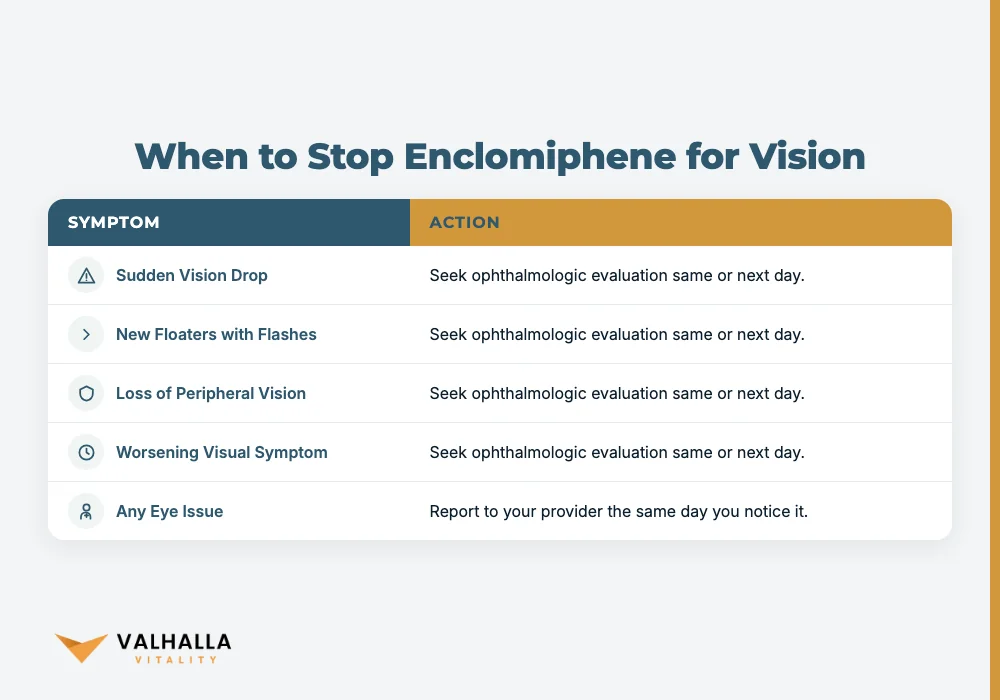
Stop therapy and seek ophthalmologic evaluation same day or next day if any of these enclomiphene vision side effects appear:
- A sudden, noticeable drop in visual clarity or acuity in one or both eyes
- New floaters appearing at the same time as flashes of light, which can indicate retinal involvement
- Loss of peripheral vision, or new persistent dark areas in the visual field
- Any visual symptom that is actively worsening rather than staying stable
These presentations require ophthalmologic evaluation, not watchful waiting. Retinal pathology, if present, needs assessment by an ophthalmologist who can perform a dilated fundus exam. That procedure allows direct visualization of the retina, optic disc, and blood vessels at the back of the eye, providing the information needed to determine whether what is happening is functional or structural.
For mild, stable enclomiphene eye floaters that appeared after starting therapy and have not changed, many providers will evaluate the clinical picture before advising on whether to pause or continue. That remains a clinical decision. Do not continue taking enclomiphene while managing a visual symptom independently.
Every enclomiphene eye issue, mild or severe, goes to your provider the same day you notice it. Speed of reporting shapes the range of responses available.
Can enclomiphene cause permanent vision damage?
Permanent vision damage from enclomiphene is rare. In most documented cases involving clomiphene-class drugs, visual symptoms have resolved after stopping the medication. That is consistent with the functional explanation: estrogen receptor disruption in the visual pathway that resolves once the compound clears.
Rare cases exist where visual changes associated with clomiphene-class drugs did not fully resolve after discontinuation. These are a minority of reported outcomes. Distinguishing between a functional disruption that will resolve and a structural change that may not requires clinical examination. A dilated fundus exam allows the ophthalmologist to directly visualize the retina and optic nerve and assess whether a structural component is present. If no structural changes are found, the exam also establishes a baseline for follow-up monitoring if symptoms persist.
Waiting weeks to see whether symptoms self-resolve is waiting weeks to find out whether a potentially reversible problem has had time to progress. The probability of permanent damage from enclomiphene vision side effects is low. It is not zero. The clinical response is the same either way: immediate provider contact and ophthalmologic evaluation when indicated.
Men who want to understand the broader clinical picture of enclomiphene use, including how providers weigh its benefits against its risks, can find a detailed overview in what enclomiphene does in the body and how it is prescribed.
What to do when enclomiphene eye problems appear
Visual symptoms during enclomiphene therapy are not a situation for self-management. They require clinical judgment.
- Contact your prescribing provider the same day. Do not wait for a scheduled check-in or assume the symptom is too minor to mention.
- Do not stop or adjust enclomiphene on your own. Stopping may be the right call, but that decision belongs to the provider who has your full clinical picture.
- Follow your provider's recommendation on ophthalmologic evaluation. A dilated fundus exam gives the specialist a direct view of the retina, optic disc, and retinal vasculature, which is the standard tool for distinguishing functional disruption from a structural change that may require intervention. If your provider recommends one, get it promptly.
- Document the symptom carefully: when it started, whether one or both eyes are affected, whether it is stable or worsening, and any concurrent visual changes.
These steps apply regardless of severity. A mild floater and a sudden drop in visual clarity both begin at the same point: contact your provider that day.
How provider-led care manages enclomiphene vision side effects
Responsible management of enclomiphene vision side effects begins before the first dose. A provider-led model includes informed consent that specifically addresses visual risk. Patients should know, before starting therapy, that enclomiphene eye floaters and related symptoms are possible, what presentations require urgent action, and how to reach their provider immediately if visual changes occur.
The reporting protocol matters for a specific reason. Telehealth providers cannot physically examine a patient. They rely on accurate, timely symptom descriptions to make sound decisions. A patient who understands what to report is better positioned to get appropriate care when enclomiphene vision side effects occur than one who waits to see if symptoms resolve.
At Valhalla Vitality, telehealth-based enclomiphene therapy includes structured informed consent alongside a clear protocol for adverse symptom reporting. When a visual symptom appears, the patient has direct access to a provider who already has the clinical context from intake. That context supports an appropriate decision on whether to monitor, pause therapy, or stop and refer for specialist evaluation.
Talk to a licensed provider
If you have questions about enclomiphene vision side effects or want professional guidance on whether this therapy is right for your situation, Book Your Consultation to connect with a licensed provider who can review your intake directly.
FAQ
Does enclomiphene cause eye floaters?
Enclomiphene can cause eye floaters in some users through its action on estrogen receptors in the retina and visual pathway. This is a class-level effect shared with clomiphene citrate, from which enclomiphene is derived. Not all users experience it, but it is a recognized clinical possibility that warrants immediate provider contact if it occurs.
How common are vision side effects with enclomiphene?
Enclomiphene vision side effects occur in a minority of users and are less frequently reported than headache or mood changes. Precise incidence data for enclomiphene specifically is limited because large-scale safety surveillance for this compound does not exist. The relative rarity of these symptoms does not reduce their clinical priority when they appear.
When should I stop taking enclomiphene due to vision changes?
Stop therapy and seek same-day or next-day ophthalmologic evaluation if you experience sudden visual acuity loss, floaters combined with flashes of light, loss of peripheral vision, or any symptom that is rapidly worsening. For mild, stable floaters, contact your provider immediately and follow their guidance rather than making the stop-or-continue decision independently.
Why does enclomiphene affect eyesight?
Enclomiphene blocks estrogen receptors in the hypothalamus to stimulate testosterone production, but estrogen receptors also exist in the retina and visual pathway. When the compound reaches those receptors, it can disrupt visual signal processing in some individuals. The effect is typically functional rather than structural, but clinical evaluation is the only way to confirm that.
Can enclomiphene cause permanent vision damage?
Permanent vision damage from enclomiphene is rare, and most documented cases of clomiphene-related visual symptoms have resolved after stopping the medication. Rare cases of persistent changes do exist, which is why prompt ophthalmologic evaluation matters rather than waiting to see whether symptoms resolve on their own.
Sources
You May Also Like
 Enclomiphene
Enclomiphene Before and After: Physical Changes Explained
Enclomiphene before and after: what physical changes to expect, how the results timeline unfolds, and why provider monitoring matters for outcomes.
October 21, 2026 ETRead more → Enclomiphene
Enclomiphene Drug Test: Detection, WADA, and Disclosure
Enclomiphene drug test detection depends on the test type. Learn how workplace panels, military screening, and WADA rules treat this SERM.
October 21, 2026 ETRead more → Enclomiphene
Enclomiphene Mood Swings: Causes and What to Expect
Enclomiphene mood swings, depression, anxiety, and sleep issues explained. Learn what causes mood changes and how provider oversight helps.
October 20, 2026 ETRead more →