Sermorelin and Testosterone: Benefits and How They Work

The following blog post is for entertainment and informational purposes only. It is not intended to provide medical advice or diagnosis. Please consult your doctor before making any health-related decisions.
Sermorelin and testosterone address two separate hormonal axes that often decline in parallel as men age. Sermorelin stimulates the pituitary to release growth hormone (GH), while testosterone replacement directly restores androgen levels. When labs confirm deficits in both systems, these hormone replacement therapies for men can be prescribed together, targeting body composition, libido, energy, and recovery through distinct but complementary pathways. A licensed provider reviews your intake and bloodwork before recommending either therapy or their combination.
How sermorelin and testosterone target different systems
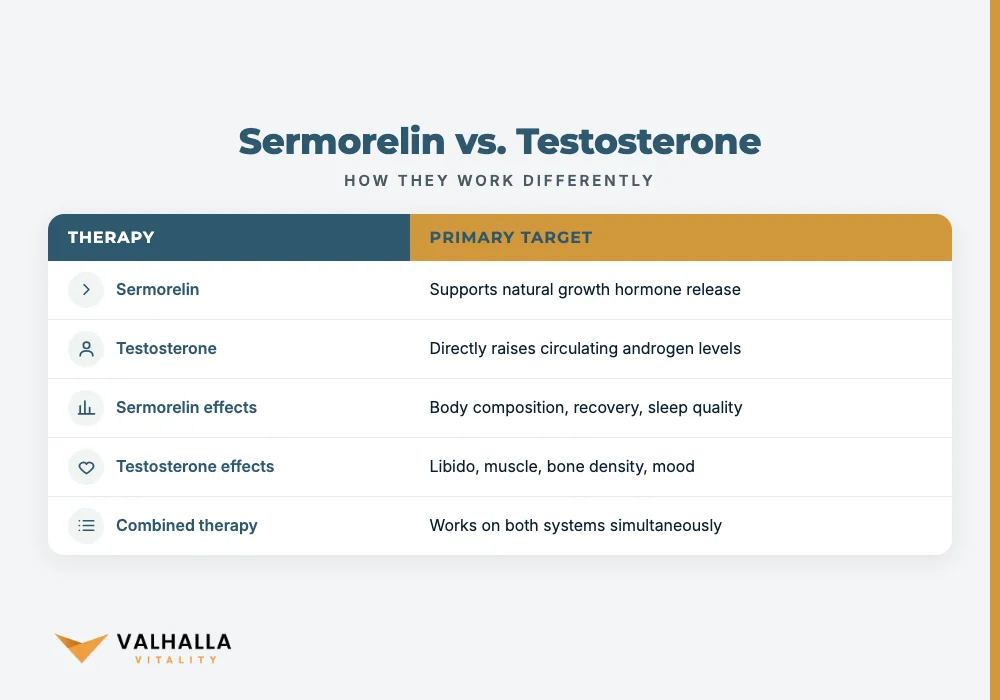
The two therapies work through entirely separate mechanisms. That distinction matters for understanding why they are sometimes prescribed together and why they are not interchangeable.
Sermorelin is a synthetic analogue of growth hormone-releasing hormone (GHRH). It binds to receptors in the anterior pituitary and triggers the natural release of GH, which then prompts the liver to produce insulin-like growth factor 1 (IGF-1). GH and IGF-1 together influence lean tissue maintenance, fat oxidation, cellular repair, and sleep architecture. Because sermorelin stimulates the body's own GH production rather than introducing exogenous GH directly, the pituitary retains its normal feedback controls.
Testosterone replacement directly raises circulating androgen levels. The 2018 Endocrine Society Clinical Practice Guideline for male hypogonadism links testosterone deficiency with reduced energy, decreased libido, muscle loss, and mood changes (Bhasin et al., 2018). The American Urological Association defines clinically significant deficiency as a total testosterone below 300 ng/dL paired with relevant symptoms (Mulhall et al., 2018).
What each therapy primarily targets:
- Sermorelin supports GH output, with downstream effects on body composition, recovery speed, and sleep quality.
- Testosterone replacement addresses androgen deficiency directly, with effects on libido, muscle protein synthesis, bone density, and mood stability.
- Combined sermorelin and testosterone therapy works on both axes simultaneously, with effects that are largely additive.
These systems can decline at different rates. Some men present with low testosterone and normal GH markers. Others show signs of GH decline while androgen levels remain adequate. A third group carries meaningful deficits in both. The lab profile determines which therapy, or combination, a provider recommends. Knowing this distinction helps explain why neither therapy is a universal solution on its own.
What are the benefits of sermorelin for men?
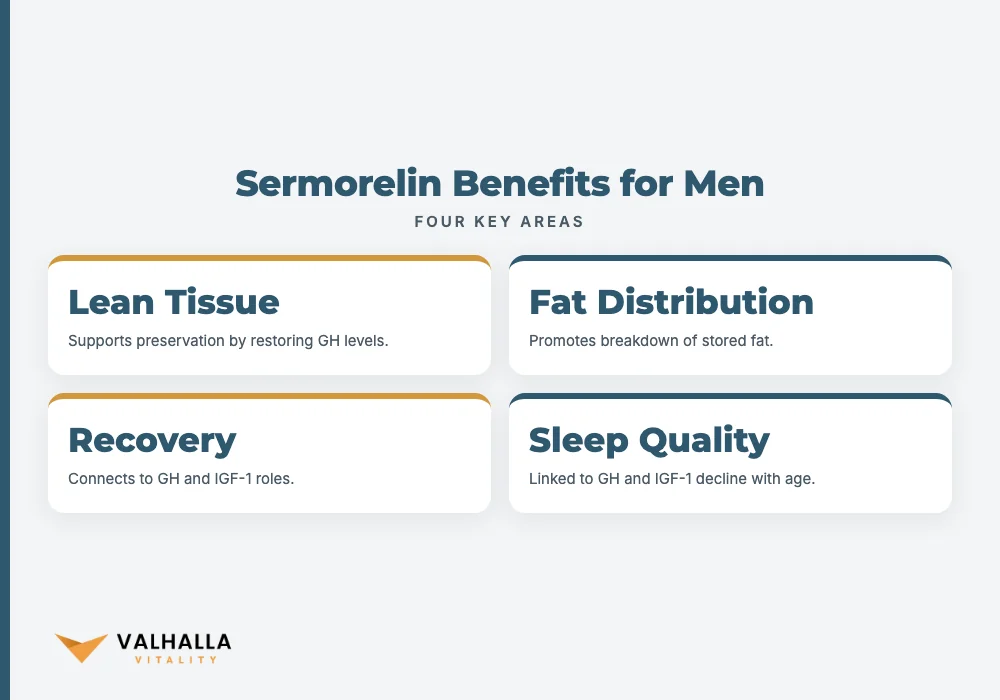
The benefits of sermorelin for men cluster around four interconnected areas: lean tissue preservation, fat distribution, recovery, and sleep quality. Each connects back to the role GH and IGF-1 play in metabolism and cellular function as they decline with age.
Lean tissue and sermorelin body composition
GH and IGF-1 both stimulate protein synthesis and satellite cell activation in skeletal muscle. When GH output falls, men often notice a gradual shift toward less lean mass and more adipose tissue, even without significant changes in diet or activity level. Sermorelin may support lean tissue preservation by restoring GH toward levels more typical of earlier adulthood.
The clinical rationale for sermorelin for muscle growth is deficit correction, not performance enhancement. When a provider also prescribes testosterone, the testosterone's direct anabolic action on androgen receptors complements sermorelin's GH-mediated pathway. This combined effect on muscle protein metabolism addresses both the androgen-receptor-dependent and GH-dependent aspects of lean tissue maintenance at the same time.
Sermorelin body composition changes tend to emerge gradually. Lean mass improvements and fat redistribution typically develop over months, and are more pronounced when both hormonal deficits are being treated concurrently.
Sermorelin fat loss and adipose distribution
GH has well-documented lipolytic properties. It promotes the breakdown of stored fat and directs the body to use fatty acids as fuel rather than storing them. This mechanism underlies the fat distribution shifts some men experience when GH output normalizes. A 2026 review in Nature Metabolism notes that testosterone also influences adipose distribution, with low androgen levels correlating with increased central adiposity (Mauvais-Jarvis et al., 2026).
Sermorelin fat loss effects and testosterone's metabolic effects may reinforce each other when both therapies are prescribed together. For context on how testosterone interacts with fat metabolism, the evidence points to overlapping but distinct pathways. This is why providers evaluating significant body composition changes consider both hormonal axes, not just one. A licensed provider determines whether one or both therapies are warranted after reviewing labs and health history.
Recovery and sleep
GH secretion naturally peaks during deep sleep. Men with declining GH output often report disrupted sleep, slower recovery between exercise sessions, and persistent fatigue unrelated to activity level. Sermorelin supports the body's overnight GH pulse, which contributes to tissue repair and sustained energy. Combined with the testosterone therapy benefits for men that include improved red blood cell production and cardiovascular efficiency, the overall effect on recovery may be more meaningful than either therapy achieves on its own.
Does sermorelin increase testosterone levels?
No, not directly. Sermorelin acts on the GH axis, not on the hypothalamic-pituitary-gonadal (HPG) axis that governs testosterone production. It does not signal the testes to produce more testosterone.
Some indirect connections exist. GH and IGF-1 receptors are present in Leydig cells, the testicular cells responsible for testosterone synthesis. Early research has suggested that GH may modestly support the hormonal environment in which testosterone is produced. The evidence, however, is not strong enough to treat sermorelin as a substitute for testosterone replacement in men with documented androgen deficiency. Men who require androgen replacement need it directly.
Does sermorelin affect testosterone production?
Sermorelin may provide modest indirect support to the broader hormonal environment, but it does not reliably raise testosterone to clinical target ranges when a meaningful deficiency exists. The 2024 clinical review in American Family Physician confirms that testosterone replacement therapy is the standard intervention for confirmed hypogonadism (Heidelbaugh et al., 2024). Sermorelin addresses a distinct deficit on a different axis and should be evaluated on its own terms, not as a workaround for testosterone therapy.
Can you take sermorelin and testosterone together?
Yes. Combining sermorelin and testosterone is clinically appropriate when labs confirm deficits in both GH status and testosterone, and when a provider determines that treating both is indicated for a given patient.
The two therapies do not interfere with each other mechanistically. Sermorelin supports GH through the pituitary's natural pathway, while testosterone replacement directly maintains androgen levels. Their effects on body composition, libido, energy, and recovery are largely additive rather than overlapping. This combination is most commonly considered in the hormone replacement therapy men receive when they present with a broader hormonal picture of decline, rather than a single isolated low reading.
Before recommending the combination, providers typically order a full hormone panel. This includes total and free testosterone, IGF-1 as a GH axis surrogate, LH, FSH, a CBC, a metabolic panel, and a PSA baseline. These results confirm whether both deficits are present, screen for contraindications, and establish the baseline for monitoring. Neither therapy is prescribed based on symptoms alone.
If you are evaluating testosterone replacement therapy options for men, understanding available protocols and delivery methods helps set realistic expectations before adding sermorelin to the picture. Some patients also ask about how adjunct therapies pair with a TRT protocol when broader hormonal support is part of the care plan.
Does sermorelin help with libido and sex drive?
Sermorelin libido benefits are real but operate indirectly. GH and IGF-1 influence vascular health and nitric oxide availability, both of which affect sexual function. Improved sleep quality from restored GH secretion also matters: chronic sleep disruption acutely suppresses testosterone, compounding the problem in men who already have lower androgen levels.
When both are combined, the libido benefit is more direct and reliable. The 2018 Endocrine Society guideline lists decreased libido as one of the primary symptoms prompting evaluation for testosterone deficiency in men (Bhasin et al., 2018). Testosterone has a well-established role in male sexual desire. Restoring it to physiological ranges may improve sexual interest and function. Sermorelin contributes through vascular health and energy, both of which factor into sexual performance and satisfaction.
For men whose reduced libido stems primarily from testosterone deficiency, sermorelin alone is unlikely to fully resolve it. The sermorelin and testosterone combination addresses both the androgen deficit and the GH-related vascular and energy factors in parallel.
Mood, energy, and cognitive function
Testosterone therapy benefits men across multiple dimensions, extending well beyond the physical. The 2026 Nature Metabolism review describes testosterone's broad metabolic role, including its influence on mitochondrial function and neurological health (Mauvais-Jarvis et al., 2026). Men with testosterone deficiency frequently cite depressed mood, cognitive fog, and reduced motivation as primary complaints, alongside the more commonly recognized physical symptoms like fatigue and low libido.
Sermorelin adds a GH-axis contribution to mood and cognition. GH signaling influences neurotransmitter balance and supports neuronal health in several brain regions. When sermorelin and testosterone are both brought toward physiological ranges, the combined effect on cognitive function and mood stability may exceed what either therapy achieves individually. These changes tend to emerge gradually, typically over weeks to months.
Neither therapy is a treatment for clinical depression or cognitive disorders. The relevant indication is mood and concentration symptoms that coincide with documented hormonal deficits, where a provider has assessed whether the hormonal picture plausibly accounts for the symptoms before recommending treatment.
What providers evaluate before combining sermorelin and testosterone
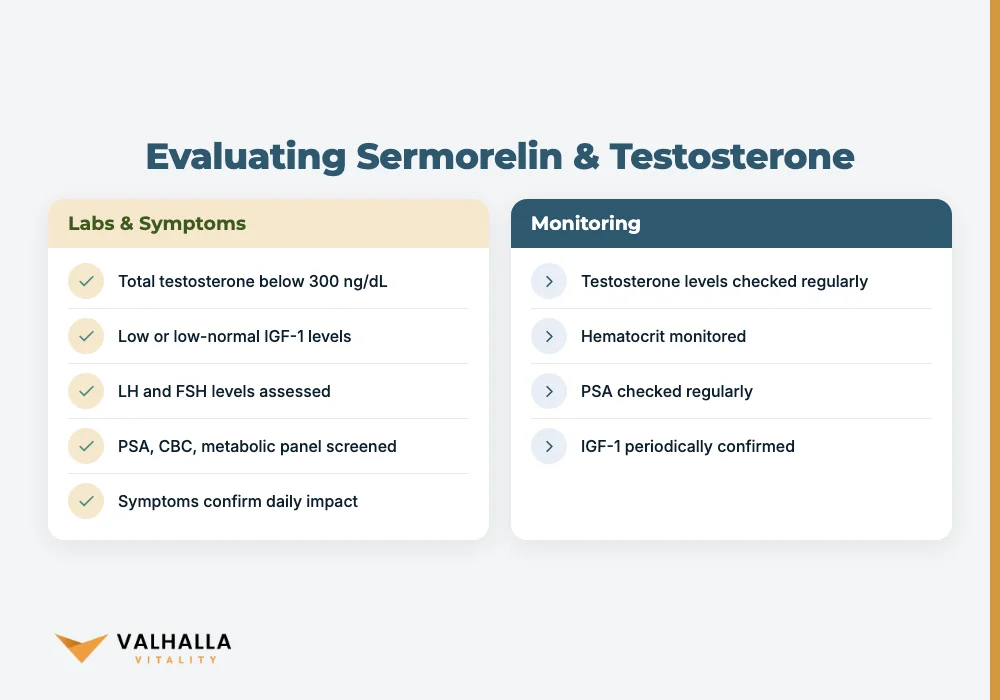
Most coverage addresses how these therapies complement each other. Less discussed is the clinical evaluation process: what labs and criteria a provider uses to determine whether combination therapy is warranted in the first place.
Lab-based criteria:
- Total testosterone below 300 ng/dL paired with symptoms, per AUA thresholds, though providers also weigh free testosterone and the overall clinical picture.
- IGF-1 level: because direct GH measurement requires stimulation testing, serum IGF-1 functions as the practical surrogate. A low or low-normal IGF-1 relative to age-matched norms supports consideration of sermorelin.
- LH and FSH: these distinguish primary from secondary hypogonadism, which affects how providers approach testosterone replacement.
- PSA, CBC, and a metabolic panel: these screen for contraindications and establish the baseline for ongoing monitoring.
Symptom assessment:
Lab values confirm the deficit; symptoms confirm its impact on daily life. The Endocrine Society recommends prescribing testosterone only when consistently low levels and attributable symptoms both exist (Bhasin et al., 2018). Providers apply similar logic to this combination: both deficits need documentation, not just clinical suspicion. Providers who operate within telehealth models typically conduct a thorough intake before reviewing lab results alongside a patient's symptom history.
Ongoing monitoring:
Once sermorelin and testosterone therapy is initiated, labs are repeated at regular intervals. Testosterone levels, hematocrit, and PSA are the standard testosterone monitoring markers. IGF-1 is checked periodically to confirm sermorelin is producing its intended GH effect. For patients who need more frequent between-visit monitoring, a Valhalla Vitality at-home lab test can make follow-up more manageable.
Safety and side effects
Sermorelin and testosterone therapy is generally well-tolerated under provider supervision. Both therapies carry considerations that require ongoing attention.
Common side effects associated with testosterone replacement include increased hematocrit, fluid retention, changes in prostate markers, and mood variability (Heidelbaugh et al., 2024). These are manageable with regular lab follow-up. Sermorelin's side effect profile tends to be milder: the most commonly reported issues are injection site reactions and temporary water retention from elevated GH.
Because sermorelin works through the body's own regulatory system rather than introducing exogenous GH, the risk of GH excess is theoretically lower than with direct GH injections. IGF-1 levels should still be monitored periodically to confirm that the GH response remains within a physiologically appropriate range.
A licensed provider determines dosing for both therapies after reviewing labs and health history. Adjustments are made based on follow-up lab values, not symptoms alone. Availability of these therapies varies by state.
At Valhalla Vitality, a licensed provider reviews your full intake and lab panel before recommending any hormone therapy, and monitoring is built into the ongoing care model.
Ready to explore your hormone health?
If you are considering sermorelin and testosterone therapy and want to know whether it fits your lab results and health profile, Book Your Consultation to speak with a licensed provider who reviews your intake and recommends a personalized approach.
FAQ
Does sermorelin increase testosterone directly?
No. Sermorelin acts on the growth hormone axis, not on the axis that controls testosterone production. It does not reliably raise testosterone in men with androgen deficiency. Testosterone replacement therapy is the appropriate intervention when labs confirm low testosterone.
Can you take sermorelin and testosterone at the same time?
Yes, when labs confirm deficits in both GH status and testosterone, providers can prescribe both therapies. They work through different mechanisms and are generally compatible. A full hormone panel is required before a provider recommends the combination.
What are the main benefits of sermorelin and testosterone combined?
The combination may support body composition, libido, energy, recovery, and mood through complementary pathways. Sermorelin targets GH-related effects on lean tissue and fat distribution, while testosterone addresses androgen-dependent functions including libido and muscle protein synthesis. Both require ongoing lab monitoring.
Does sermorelin help with libido specifically?
Sermorelin may support libido indirectly through improved vascular health and sleep quality. For men with documented testosterone deficiency, testosterone replacement typically has a more direct effect on sexual desire. Many providers address both deficits together when labs confirm both are present.
How does a provider decide whether to combine sermorelin and testosterone?
The decision rests on lab results: IGF-1 as a GH surrogate, total and free testosterone levels, and a symptom assessment. Both deficits need to be documented, not just suspected. Availability of these therapies varies by state.
Sources
- Bhasin S et al. (2018). Testosterone Therapy in Men With Hypogonadism: An Endocrine Society Clinical Practice Guideline. The Journal of Clinical Endocrinology and Metabolism. PubMed
- Mulhall JP et al. (2018). Evaluation and Management of Testosterone Deficiency: AUA Guideline. The Journal of Urology. PubMed
- Heidelbaugh JJ et al. (2024). Testosterone Replacement Therapy for Male Hypogonadism. American Family Physician. PubMed
- Mauvais-Jarvis F et al. (2026). Metabolic Messengers: testosterone. Nature Metabolism. PubMed
You May Also Like
 Enclomiphene
 Mood Swings: Causes and What to Expect
Enclomiphene mood swings, depression, anxiety, and sleep issues explained. Learn what causes mood changes and how provider oversight helps.
October 20, 2026 ETRead more → Enclomiphene
 FDA approval 2026: what men should know
Enclomiphene FDA approval 2026: understand the current regulatory status, how it differs from clomid, and what availability looks like for US men.
October 20, 2026 ETRead more → Enclomiphene
 and Pregnenolone: Men's Hormone Stack Guide
Enclomiphene and pregnenolone may support testosterone and hormonal balance in men. Explore how this hormone stack works and when to consider it.
October 20, 2026 ETRead more →